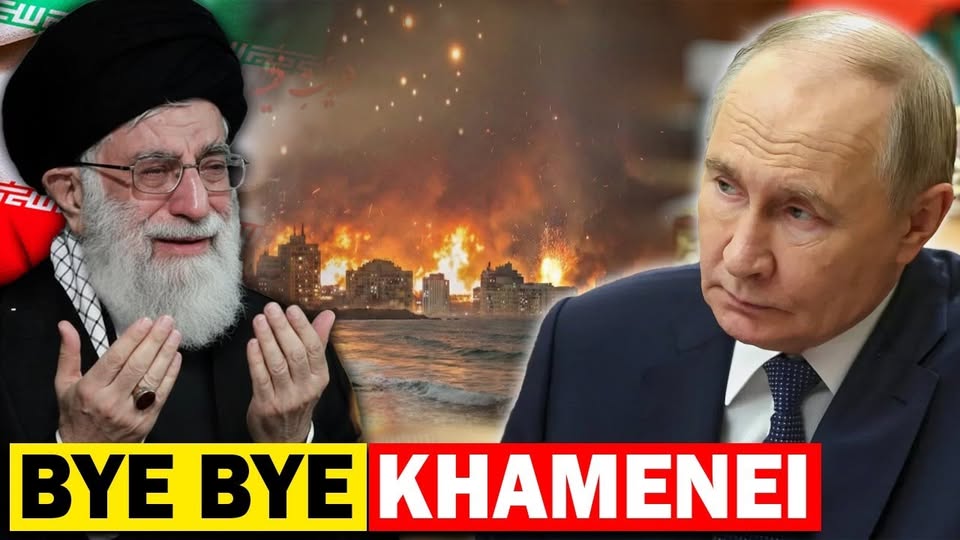
Iran has lost the biggest gamble in its history! Tehran supplied Russia’s war machine with thousands of drones, but when the day of reckoning came, Moscow closed its doors. While the Russian Duma declares, ‘We will not fight for Iran,’ Rosatom is planning to evacuate Russian personnel from the Bushehr Nuclear Power Plant. The Su-35s never arrived, and the S-300s are as helpless as they were in Venezuela. Even the Caspian Sea route is no longer secure.

In this video, we analyse the collapse of the Russia-Iran alliance and Tehran’s strategic isolation:
DIPLOMATIC COOLING: Why did Pezeshkian return empty-handed from Moscow?
NUCLEAR EVACUATION: Why is Russia evacuating the Bushehr plant?
TECHNOLOGICAL FAILURE: Why are Russian air defence systems ‘blind’ against US aircraft?
BREAKDOWN IN THE CASPIAN: How did Ukraine cut off Russia’s aid route to Iran?
Suddenly, Vladimir Putin appears willing to throw Iran under the bus. For the United States, this is not just a moment—it is an opening.
Writing in The Telegraph (January 2026), Dr. Ivana Stradner of the Foundation for Defense of Democracies argues that Russia’s wartime desperation has exposed a fatal weakness at the heart of the Kremlin’s foreign alliances: Moscow cannot, and will not, protect its partners when the cost becomes too high.
Russia has spent years cultivating ties with Iran, China, and other adversaries of the West, presenting itself as a reliable counterweight to American power. But the grinding war in Ukraine—compounded by sanctions, battlefield losses, and strikes on critical infrastructure—has stripped away that illusion.
Behind the rhetoric, Russia’s alliances are fracturing. Moscow is increasingly consumed by its own survival, leaving little capacity or willingness to defend allies in crisis. The recent turmoil involving Iran, coupled with Russia’s inability to prevent the collapse of Assad’s grip in Syria, has sent a clear message: Kremlin loyalty is conditional—and expendable.
This moment presents a strategic opportunity for Washington.
As Russia weakens, its credibility as a security guarantor collapses with it. The United States can expose the Kremlin’s “friendship” for what it is—transactional, self-serving, and unreliable—and force Russia’s partners to confront an uncomfortable truth: when pressure mounts, Moscow walks away.
With Russian influence eroding across the Middle East and Central Asia, the U.S. has a chance to offer alternative partnerships and accelerate the unraveling of what Stradner terms the “Axis of Upheaval”—Russia, Iran, China, and North Korea.
The lesson is stark and increasingly visible: Russia demands loyalty, but offers no protection. And that realization may do more to isolate Moscow than any sanction ever could.