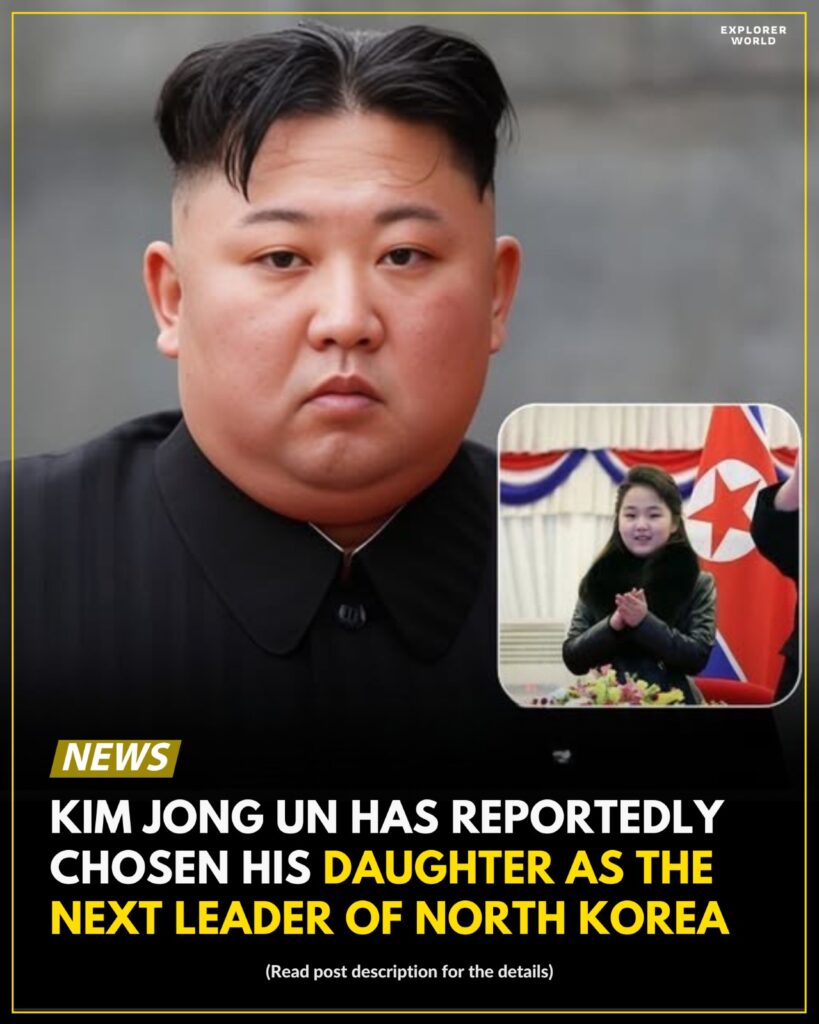
A new wave of global attention is focusing on the future of leadership in one of the world’s most secretive nations. Reports indicate that Kim Jong Un may be positioning his daughter as a potential future successor—an unprecedented possibility that could see North Korea led by its first female head of state.
While there has been no official confirmation from Pyongyang, her increasingly frequent and carefully choreographed public appearances alongside her father have fueled intense speculation among analysts, diplomats, and intelligence observers worldwide. In a political system where symbolism is deliberate and succession planning has historically been tightly controlled, even the smallest detail can carry enormous significance.
A Carefully Orchestrated Presence
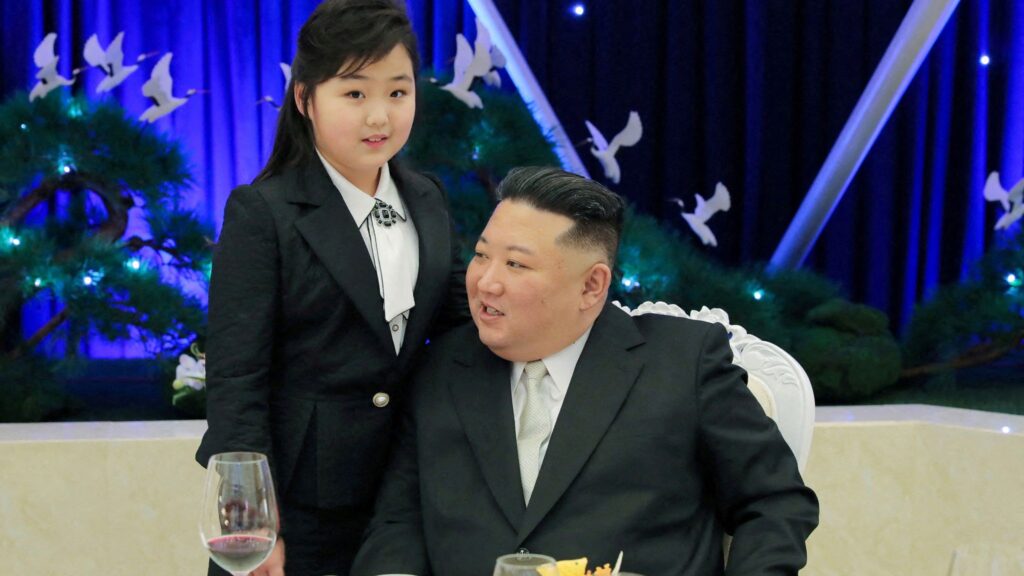
Over the past several years, Kim Jong Un’s daughter—believed to be named Kim Ju Ae, though this has not been formally acknowledged by the regime—has appeared beside him at major national events. These include intercontinental ballistic missile (ICBM) test launches, military parades, defense exhibitions, and high-profile state gatherings.
In North Korea’s political culture, such visibility is not random. Every public image, every seating arrangement, and every official photograph is meticulously curated to project authority and legitimacy. Her placement beside the leader—often holding his hand or standing prominently in official media images—has drawn comparisons to past leadership transitions within the ruling Kim dynasty.
Unlike earlier eras when heirs were shielded from public view until closer to succession, this strategy appears to introduce the possibility of a generational handover well in advance. Observers suggest that this may be a calculated effort to normalize her presence among the North Korean population and elite.
A Historic First?
If the speculation proves accurate, her eventual rise would mark a historic shift. North Korea has been ruled by three generations of men from the Kim family: Kim Il Sung, Kim Jong Il, and Kim Jong Un. A female leader would represent a significant symbolic transformation in a system deeply rooted in patriarchal traditions.
However, while the country’s governance structure is highly centralized, it is also pragmatic when it comes to preserving dynastic continuity. Loyalty to the bloodline—often referred to as the “Mount Paektu lineage”—has long been emphasized as the foundation of political legitimacy. In this context, gender may be secondary to maintaining the continuity of the ruling family.
Analysts note that positioning a daughter as successor could also serve as a powerful propaganda narrative, reinforcing the idea of generational stability and long-term national vision.
Strategic Messaging to Domestic and Global Audiences
Her appearances at military events have been especially telling. She has been seen observing missile tests and standing alongside top generals. These optics send a message not only to North Korea’s domestic audience but also to the international community.
To citizens inside the country, it may signal continuity and reassurance that leadership stability is being carefully managed. For international observers, it hints at long-term planning within the regime rather than short-term political maneuvering.
North Korea’s political history shows that succession is rarely accidental. When Kim Jong Un himself was introduced to the public during the final years of Kim Jong Il’s rule, his rise was swift and meticulously orchestrated. The current situation, however, appears more gradual—perhaps reflecting lessons learned from previous transitions.
Calculated Stability in an Uncertain World
The geopolitical implications of such a move are significant. North Korea remains a central player in East Asian security dynamics, particularly in relation to South Korea, the United States, China, and Japan. Any indication of leadership transition invites scrutiny regarding policy continuity, nuclear strategy, and diplomatic posture.
If Kim Jong Un is indeed preparing a long-term succession plan, it may reflect a desire to prevent internal power struggles and ensure regime survival beyond his tenure. Stability within the leadership structure reduces the risk of factional competition, which could destabilize the tightly controlled political system.
Moreover, by introducing a successor early, the regime may be attempting to build familiarity and loyalty within the military and party elite—two pillars essential to maintaining authority in Pyongyang.
Youth as a Political Symbol
Another notable element is her youth. Presenting a young successor could serve to project longevity and forward-looking governance. It signals that the ruling family anticipates decades of continued leadership under the Kim dynasty.
This approach contrasts sharply with many authoritarian systems where succession planning remains opaque until a leader’s health declines. Instead, this strategy may aim to remove uncertainty and demonstrate confidence in long-term stability.
At the same time, experts caution against reading too much into limited public information. North Korea’s internal politics remain highly secretive, and definitive conclusions are difficult without confirmation from official sources.
The Role of Image and Narrative
State media coverage of her appearances has been unusually respectful, at times using language that some analysts interpret as signaling elevated status. Titles and descriptive phrases in official reports are closely examined for clues about rank and authority.
In a country where propaganda shapes public perception, these nuances matter. The cultivation of an heir requires more than visibility—it requires narrative construction. By placing her at pivotal moments in national defense and security events, the regime may be embedding her within the story of national strength and sovereignty.
International Reaction and Cautious Analysis
Governments and intelligence agencies worldwide are watching closely. While no policy shifts have been announced, the prospect of a future female leader in North Korea introduces questions about potential generational changes in diplomatic approach.
Would a new leader pursue the same hardline military posture? Could generational transition open doors to different economic or diplomatic strategies? Or would continuity remain absolute?
Most analysts emphasize that institutional inertia within the regime is strong. Even if leadership changes, core policies—especially regarding nuclear weapons and strategic defense—are likely to remain consistent.
Continuity Over Change
Ultimately, the speculation surrounding Kim Jong Un’s daughter underscores one central theme: continuity. The Kim dynasty has governed North Korea for more than seven decades, and preserving that lineage has always been paramount.
By possibly introducing his daughter as a future successor, Kim Jong Un may be reinforcing the narrative that the nation’s direction is secure and predetermined. In a system where uncertainty can breed instability, long-term planning becomes a political tool.
At the same time, the world remains cautious. Without formal declarations or constitutional adjustments, any discussion of succession remains speculative. North Korea has a history of strategic ambiguity, and official confirmation may not come for years—if at all.
A Moment of Global Attention
For now, the growing visibility of Kim Jong Un’s daughter continues to draw international headlines. Each public appearance is dissected, every photograph analyzed, every speech parsed for hidden meaning.
Whether this signals the early stages of a historic leadership transition or simply a symbolic gesture remains to be seen. What is clear, however, is that the possibility of North Korea’s first female head of state represents a significant moment in the political narrative of one of the world’s most closely watched nations.
As observers continue to monitor developments, one thing is certain: in Pyongyang, nothing is accidental. And when it comes to succession, history suggests that every step is deliberate, calculated, and designed with long-term survival in mind.
The world will be watching closely for the next sign—however subtle—of what the future may hold.