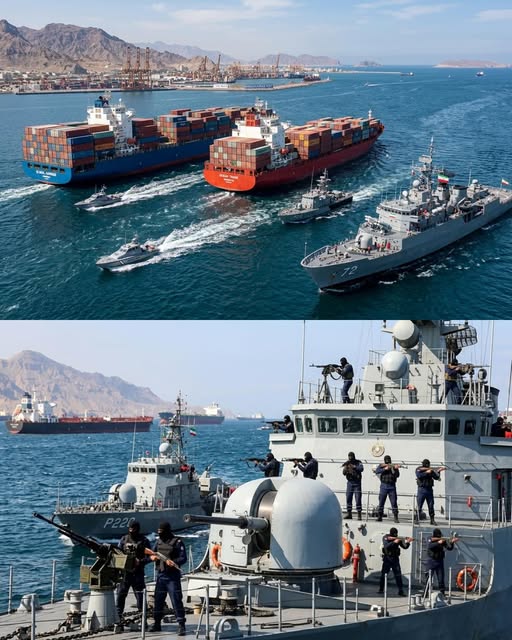
The vessels, which had around 40 crew members onboard, were taken under Iranian control following their seizure by the Islamic Revolutionary Guard Corps (IRGC).
🚨🇮🇷 Shockwaves in the Gulf: Iran Escalates Maritime Standoff After Seizing Two Container Ships
Tensions in the Middle East have surged to a new and dangerous level after Iran escorted two seized container ships to the strategic port of Bandar Abbas, following their capture near the vital Strait of Hormuz — one of the most critical waterways in global trade.
According to reports from Reuters, the vessels, carrying roughly 40 crew members from multiple countries, were intercepted and taken under the control of Iran’s powerful Islamic Revolutionary Guard Corps (IRGC). The incident has sent shockwaves across global shipping networks, financial markets, and diplomatic circles, raising urgent questions about what comes next.
🌊 A High-Stakes Seizure in a Global Chokepoint
The Strait of Hormuz is no ordinary stretch of water. Narrow, heavily trafficked, and geopolitically volatile, it serves as the gateway for nearly 20% of the world’s oil and liquefied natural gas shipments. Any disruption here instantly reverberates across the global economy.
In this already tense environment, Iranian forces reportedly moved decisively. Armed IRGC units boarded the ships after intercepting them as they attempted to transit the strait. Witness accounts suggest a swift and forceful takeover, with commandos asserting control and redirecting the vessels toward Iranian territorial waters.
Within hours, both ships were under Iranian escort, heading toward Bandar Abbas — a major naval and commercial hub that now serves as the center of this unfolding crisis.
⚓ Who Are the Ships — and Why Were They Targeted?
The seized vessels are believed to be linked to major international shipping operations, including one connected to the world’s largest container shipping company. Crews onboard include a mix of Ukrainian, Filipino, and European sailors — ordinary seafarers now caught in a geopolitical storm far beyond their control.
Iran has justified the seizure by accusing the ships of violating maritime regulations, including operating without proper permits and allegedly manipulating navigation systems.
But analysts say the move is about much more than paperwork.
This is widely seen as retaliation — part of an escalating tit-for-tat confrontation following the recent interception of an Iranian vessel by U.S. forces.
In other words, the ships may not just be targets — they may be messages.
🔥 A Region on Edge
The timing of the incident is critical. The Middle East is already simmering with tension following months of conflict, naval confrontations, and economic pressure. Shipping lanes have become increasingly militarized, with warships, drones, and surveillance aircraft constantly monitoring the waters.
Recent data shows that traffic through the Strait of Hormuz has dropped dramatically, with only a fraction of the usual number of ships passing through daily due to safety concerns and ongoing hostilities.
For global trade, this is a nightmare scenario.
Oil prices have already reacted sharply, surging amid fears of prolonged disruption.
Insurance costs for vessels operating in the region have skyrocketed.
Shipping companies are scrambling to reroute cargo — often at enormous expense.
And now, with ships being seized and escorted into foreign ports, the risks have become impossible to ignore.
👥 The Human Story: 40 Lives in Uncertainty
Amid the geopolitical drama, the fate of the crews remains a central concern.
Around 40 sailors are currently aboard the seized ships, reportedly safe but under restricted movement. Their families, scattered across continents, are anxiously awaiting updates.
Governments from multiple countries have begun urgent diplomatic efforts to secure their release. Behind the scenes, negotiations are underway — involving shipping companies, foreign ministries, and Iranian authorities.
For the crew, the experience is likely tense and uncertain: confined to a vessel under military control, surrounded by armed personnel, and unsure of what the coming days may bring.
⚖️ Power, Politics, and Messaging
Iran’s actions are not occurring in isolation. They are part of a broader strategic play — one that blends military pressure, economic leverage, and symbolic messaging.
By seizing ships in such a critical waterway, Tehran is demonstrating its ability to disrupt global trade at will — a powerful bargaining chip in any negotiation.
The message is clear:
- Iran can control access to one of the world’s most important shipping routes
- It can respond forcefully to perceived threats or actions
- And it is willing to escalate when challenged
At the same time, the move raises the risk of miscalculation. With multiple military forces operating in close proximity, even a small incident could spiral into a much larger confrontation.
🌍 Global Consequences: More Than Just Ships
This is not just a regional issue — it’s a global one.
The Strait of Hormuz is a lifeline for energy markets. Any prolonged disruption could impact:
- Fuel prices worldwide
- Supply chains across industries
- Inflation in already fragile economies
- Energy security for major importing nations
Already, the ripple effects are being felt. Shipping companies are reassessing routes. Governments are issuing advisories. Markets are reacting in real time.
What began as the seizure of two ships could evolve into a much larger crisis — one with far-reaching consequences.
🔮 What Happens Next?
For now, all eyes are on Bandar Abbas.
Will Iran release the ships after negotiations?
Will there be further seizures or retaliatory actions?
Or is this the beginning of a sustained maritime standoff?
Diplomacy will play a critical role in the coming days. But in a region where tensions are high and trust is low, outcomes remain uncertain.
One thing, however, is clear:
The waters of the Strait of Hormuz have become more dangerous than ever — and the world is watching closely.