For decades, Mars has loomed as both a tantalizing destination and a stubborn challenge. The Red Planet is close enough to capture humanity’s imagination, yet far enough to expose the brutal limits of current space technology. Traditional chemical rockets—powerful but inefficient—have long dictated the rhythm of interplanetary travel, stretching voyages to Mars to around 300 days. That timeline brings with it immense challenges: prolonged exposure to cosmic radiation, muscle and bone degradation for astronauts, and the psychological strain of months confined in deep space.
Now, a breakthrough from Russia may dramatically change that equation.
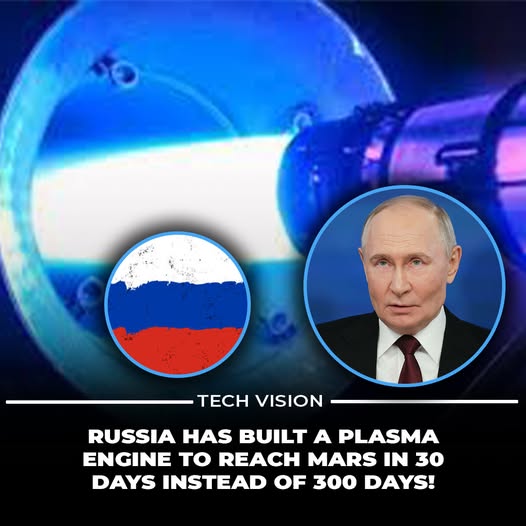
Russia’s state nuclear corporation, Rosatom, has unveiled a prototype plasma rocket engine that could slash travel time to Mars from nearly a year to as little as 30 to 60 days. If realized, this technology would not merely improve spaceflight—it could fundamentally reshape how humans explore the solar system.
A Radical Leap Beyond Chemical Rockets
At the heart of this breakthrough lies a fundamental shift in propulsion philosophy.
Conventional rockets rely on chemical combustion, burning fuel to generate thrust. While reliable and powerful at launch, chemical engines are inherently limited. Their exhaust velocity—roughly 4.5 kilometers per second—caps how fast spacecraft can ultimately travel. Once the fuel is burned, acceleration stops, leaving spacecraft to coast for months.
The plasma engine developed by Rosatom’s scientists shatters this limitation.
Rather than relying on combustion, the new engine uses magnetic plasma accelerators to propel charged particles—specifically hydrogen ions—at astonishing speeds of up to 100 kilometers per second (about 223,000 miles per hour). That’s more than 20 times faster than the exhaust velocity of today’s chemical rockets.
This difference is transformative. Higher exhaust velocity means far greater efficiency, allowing spacecraft to continue accelerating for extended periods instead of relying on a short burst of thrust at departure.
Inside the Troitsk Institute’s Plasma Engine
The engine was developed at the Troitsk Institute, one of Russia’s premier research centers for advanced physics and energy systems. There, scientists have been quietly working on plasma propulsion concepts that blur the line between aerospace engineering and nuclear science.
The prototype operates in what researchers describe as a “pulse-periodic” mode. Instead of a continuous stream, the engine fires rapid pulses of energized plasma, each one accelerated by powerful magnetic fields. The result is a steady, sustained push—gentle but relentless.
With an average power of 300 kilowatts, the engine produces a relatively modest thrust of about 6 Newtons—roughly equivalent to the weight of a small apple on Earth. By terrestrial standards, that may sound insignificant. In space, however, where there is no air resistance and gravity is minimal, even small thrust applied continuously can yield enormous velocity over time.
This is the key to plasma propulsion’s promise: continuous acceleration.
Why Low Thrust Can Mean High Speed
To understand the significance of Rosatom’s plasma engine, it helps to rethink how speed works in space.
Chemical rockets are like sprinters—explosive bursts of power that quickly burn through fuel. Plasma engines, by contrast, are marathon runners. They accelerate slowly but persistently, building speed day after day, week after week.
A spacecraft equipped with such an engine could accelerate halfway to Mars, flip orientation, and then decelerate for the remainder of the journey. This constant control not only shortens travel time but also improves navigation precision and safety.
Most importantly, it opens the door to human missions that are far less punishing on the body.
Cutting Radiation Risk in Deep Space
One of the greatest dangers of interplanetary travel is cosmic radiation. Outside Earth’s protective magnetic field, astronauts are exposed to high-energy particles that can damage DNA, increase cancer risk, and impair cognitive function.
A 300-day journey to Mars means nearly a year of cumulative radiation exposure—before astronauts even begin their mission on the planet’s surface.
By reducing transit time to 30–60 days, Rosatom’s plasma engine could dramatically lower that risk. Shorter journeys mean less radiation, fewer health complications, and a greater likelihood that crews arrive physically and mentally fit for the demanding work ahead.
This alone makes the technology a potential game-changer for crewed deep-space exploration.
Testing the Engine on Earth
Before such ambitions can become reality, the technology must prove itself under rigorous testing.
Rosatom’s prototype is currently being evaluated in a large vacuum chamber, designed to replicate the near-perfect vacuum of space. Inside, engineers monitor plasma stability, magnetic field integrity, energy efficiency, and thermal performance.
These tests are crucial. Plasma engines must operate reliably for months at a time without mechanical failure, plasma instability, or degradation of internal components. Even minor inefficiencies can become major problems over interplanetary distances.
So far, Rosatom officials have expressed confidence in the results, describing the prototype as a major milestone rather than a speculative experiment.
The Nuclear Connection
One reason Rosatom is uniquely positioned to develop such technology lies in its expertise in nuclear energy systems.
High-power plasma engines require substantial and consistent energy sources—far more than solar panels can realistically provide for rapid interplanetary travel. While the prototype currently operates in laboratory conditions, future flight-ready versions are expected to integrate compact nuclear power units capable of generating hundreds of kilowatts continuously.
This combination—nuclear power and plasma propulsion—represents one of the most promising pathways toward fast, sustainable deep-space travel.
Aiming for 2030: Ambition Meets Reality
Rosatom has stated its goal clearly: a flight-ready plasma rocket engine by 2030.
That timeline is ambitious but not implausible. Over the next several years, researchers will need to scale up the engine, refine its efficiency, integrate it with spacecraft systems, and demonstrate long-duration reliability. Each step presents technical and engineering challenges that cannot be rushed.
If successful, however, Russia could emerge as a global leader in next-generation space propulsion, rivaling or even surpassing efforts underway in the United States, Europe, and China.
Global Implications for Space Exploration
The unveiling of Rosatom’s plasma engine comes at a moment of renewed international interest in Mars. NASA, SpaceX, China’s CNSA, and the European Space Agency all have long-term ambitions for crewed missions to the Red Planet.
A propulsion system capable of cutting travel time by two-thirds or more would alter mission planning across the board. Supply chains, crew rotation strategies, spacecraft design, and even geopolitical dynamics in space could be reshaped.
In this sense, Rosatom’s breakthrough is not just a technological development—it is a strategic one.
Beyond Mars: Opening the Solar System
While Mars captures the spotlight, the implications of plasma propulsion extend far beyond a single destination.
Continuous high-speed acceleration could make missions to the asteroid belt, Jupiter’s moons, and even the outer solar system more feasible within human timescales. Scientific probes could reach distant targets faster, gather more data, and respond to discoveries in near real time.
For humanity’s long-term future in space, such capabilities are essential.
A New Chapter in the Space Age
Since the dawn of the Space Age, propulsion has been the defining constraint of exploration. From the roaring engines of Saturn V to today’s reusable rockets, progress has been incremental rather than revolutionary.
Rosatom’s plasma rocket engine hints at something different—a true paradigm shift.
While many hurdles remain before astronauts ride plasma-powered spacecraft to Mars, the unveiling of this prototype marks a powerful statement: the era of slow, months-long interplanetary travel may not last forever.
If the promise holds, the journey to Mars could soon feel less like an endurance test—and more like the opening chapter of humanity’s next great adventure among the stars.