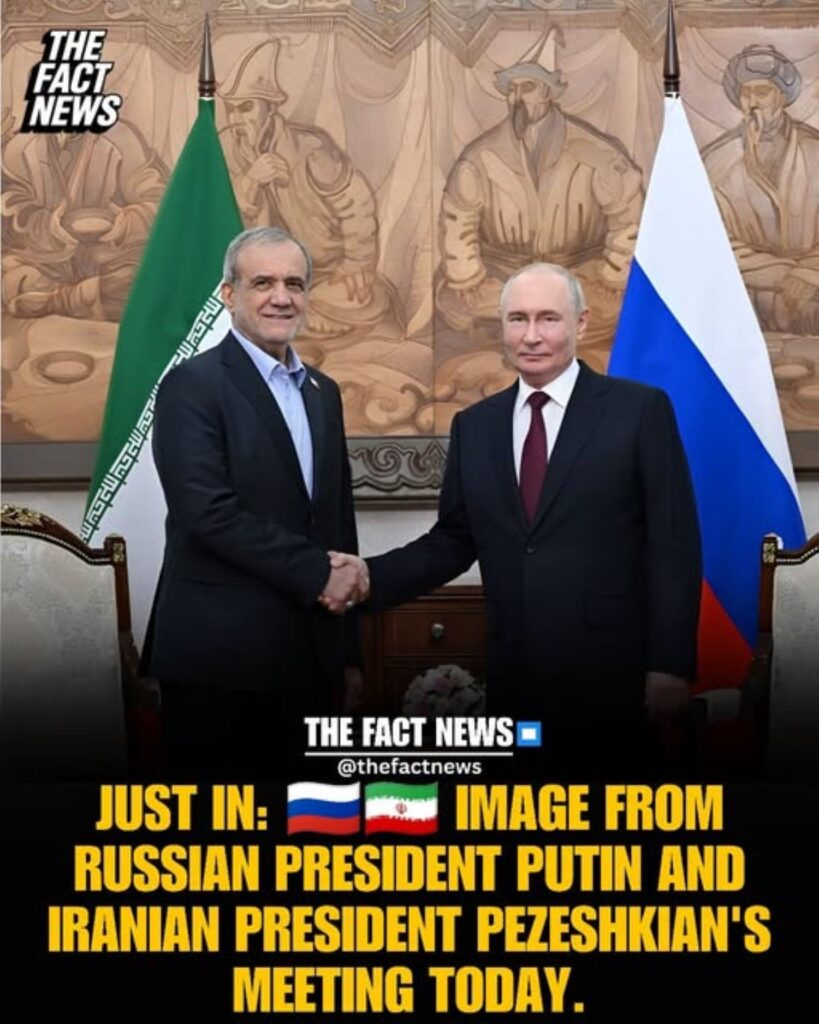
Russian President Vladimir Putin and Iranian President Masoud Pezeshkian held talks on the sidelines of the Shanghai Cooperation Organisation (SCO) summit in Bishkek, Kyrgyzstan, as Moscow and Tehran seek to strengthen their partnership amid growing tensions across the region.
The meeting brought together two leaders whose countries have increasingly expanded political, diplomatic and economic cooperation in recent years. Their discussions focused on bilateral relations as well as major regional conflicts, with both sides facing a rapidly changing geopolitical environment.
For Tehran, relations with Moscow have become an important element of its foreign policy as tensions with the United States remain high. During the meeting, Pezeshkian expressed appreciation for Russia’s diplomatic position toward Iran, highlighting what Tehran sees as Moscow’s support during a period of heightened international pressure.
Pezeshkian emphasized the importance of continued cooperation between Iran and Russia, portraying their relationship as a way to resist what he described as Western unilateralism. His remarks reflected Tehran’s broader effort to build closer relationships with countries outside the traditional Western alliance system.
The Iranian president’s message also underscored the growing strategic importance of Moscow-Tehran ties. Both countries have sought to expand cooperation across several areas, including trade, energy, transportation, security and diplomacy. Their governments have repeatedly emphasized the value of a more multipolar international system in which no single group of countries dominates global decision-making.
For Putin, strengthening ties with Iran also carries significant regional importance. Russia has sought to maintain its influence across the Middle East and deepen partnerships with countries that share concerns about Western pressure and sanctions. Iran, meanwhile, remains a major regional power with significant influence across the Middle East and extensive energy resources.
The meeting came against the backdrop of multiple regional crises and increasingly complicated relations between major global powers. Conflicts and security tensions across the Middle East have created additional challenges for Russia and Iran, while their relationship with the United States remains marked by deep disagreements.
Against this backdrop, the Putin-Pezeshkian meeting carried significance beyond traditional bilateral diplomacy. It demonstrated the continued willingness of Moscow and Tehran to coordinate their positions at a time when international alliances and partnerships are being reshaped.
Pezeshkian’s acknowledgment of Russia’s diplomatic stance was particularly notable. Tehran has faced sustained pressure from Washington over a range of issues, while Moscow itself has experienced extensive Western sanctions and diplomatic confrontation. The two governments therefore share an interest in developing mechanisms for cooperation that can reduce their vulnerability to external pressure.
Economic cooperation is another important part of the relationship. Russia and Iran have discussed expanding trade and transportation links, improving connectivity and increasing cooperation in strategic sectors. Greater economic integration could provide both countries with additional opportunities as they navigate restrictions imposed by Western governments.
Yet the partnership also faces challenges. Differences in national interests, regional priorities and economic circumstances mean that cooperation does not necessarily translate into complete agreement on every issue. Both governments must balance their broader strategic relationship with their individual foreign-policy objectives.
Still, the meeting between Putin and Pezeshkian sent a clear diplomatic message: Russia and Iran intend to continue strengthening their relationship.
As global tensions remain elevated, Moscow and Tehran appear increasingly focused on closer coordination, expanded economic ties and diplomatic cooperation. Whether their partnership can develop into an even deeper strategic alignment will depend on how both countries respond to the conflicts and geopolitical pressures shaping the region.
For now, the talks in Bishkek highlighted the growing importance of the Russia-Iran relationship—and the increasingly complex network of partnerships emerging beyond the traditional Western sphere.