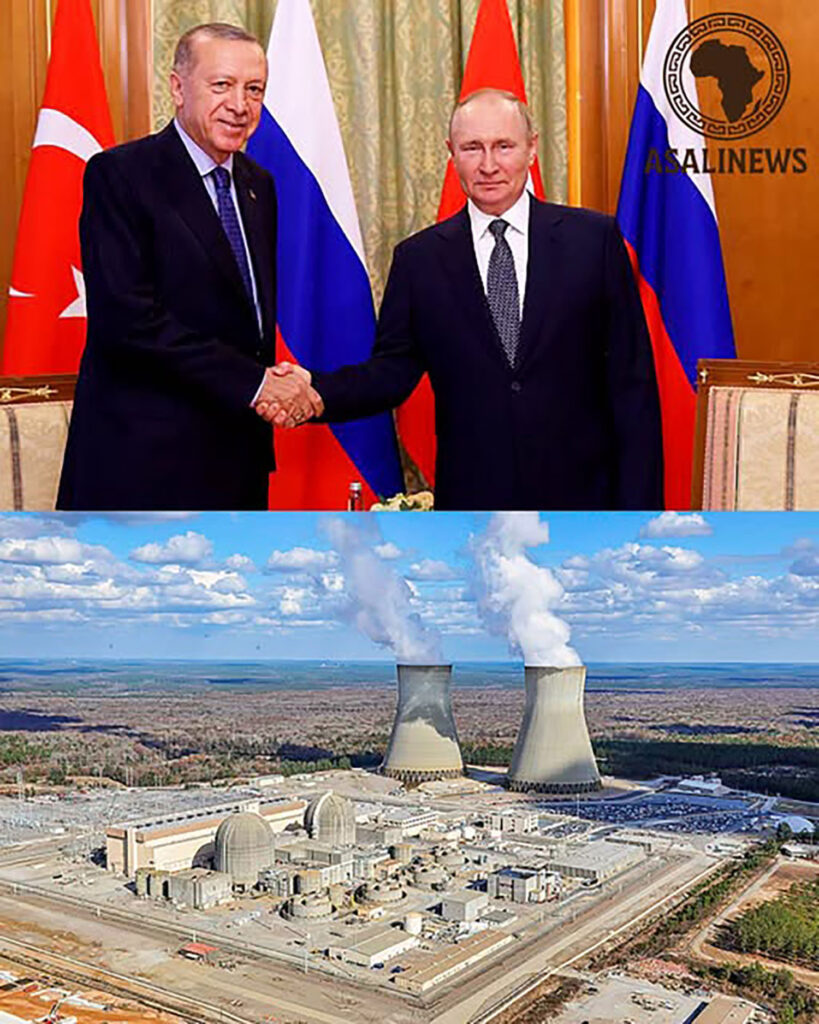
Turkish President Recep Tayyip Erdogan has proposed expanding nuclear cooperation with Russia beyond the Akkuyu plant.
A major new question is emerging from Turkey’s increasingly complex relationship with Russia: Could Ankara be preparing to expand its nuclear partnership with Moscow far beyond the Akkuyu power plant?
Turkish President Recep Tayyip Erdogan has signaled that the answer could be yes.
During a meeting with Russian President Vladimir Putin on the sidelines of the Shanghai Cooperation Organisation summit in Bishkek, Kyrgyzstan, Erdogan said Turkey and Russia could move forward with additional nuclear power projects once the Akkuyu plant is inaugurated.
His comments marked a significant development in an already close energy relationship between Ankara and Moscow. Erdogan described Turkey-Russia relations as being at a more advanced level than in previous periods and highlighted Akkuyu as an important symbol of bilateral cooperation.
“We are now in the completion phase of the Akkuyu Power Plant,” Erdogan said, adding that once the facility opens, the two countries would take steps together toward additional plants.
The statement immediately raises a bigger question: What exactly does Turkey have in mind for its next generation of nuclear power stations—and how large a role will Russia play?
Akkuyu is only the beginning
Akkuyu, located on Turkey’s Mediterranean coast in Mersin province, is the country’s first nuclear power plant. The project is being built by Russia’s state-owned nuclear company Rosatom and will eventually consist of four reactors with a combined capacity of about 4,800 megawatts.
The project has been closely watched for years because it represents one of the most ambitious examples of Russian-Turkish energy cooperation.
In June 2026, Rosatom announced that construction of the first unit had been completed and that commissioning preparations were underway. Putin subsequently told Erdogan that Rosatom remained on schedule to launch the first unit during 2026.
For Turkey, the project is intended to provide a major new source of electricity while reducing dependence on imported energy. The completed four-reactor facility is expected to generate a substantial share of Turkey’s electricity.
For Russia, meanwhile, Akkuyu represents more than the construction of a power station. It gives Rosatom a long-term role in Turkey’s nuclear-energy sector and strengthens an economic relationship that already includes energy, trade and tourism.
Erdogan wants to go further
Erdogan’s latest remarks suggest Ankara is not treating Akkuyu as a one-off project.
Turkey has broader plans to expand its nuclear capacity, including potential projects in Sinop in northern Turkey and Thrace in the northwest. However, Erdogan did not specifically identify those sites during his meeting with Putin.
That distinction matters.
Ankara has previously examined different international partners for future nuclear projects, including companies from countries such as South Korea and Canada. The latest comments therefore raise the possibility that Russia could seek a larger role in Turkey’s nuclear expansion.
If Moscow eventually becomes involved in additional plants, the relationship could move from a single flagship project toward a much broader, long-term nuclear partnership.
Putin welcomes the opportunity
Putin, for his part, described Turkey as one of Russia’s “privileged partners” and expressed confidence that Rosatom would bring Akkuyu’s first unit online this year.
The Russian president’s comments underline how strategically important the Turkish relationship has become for Moscow.
Russia and Turkey remain divided over a number of international issues, but their governments have continued to cooperate in areas where their interests overlap. Energy is one of the most important.
That cooperation has become particularly significant as both countries navigate a complicated international environment.
The NATO question
And this is where Erdogan’s nuclear proposal becomes especially significant.
Turkey is a member of NATO, while Russia is regarded by the alliance as its principal security challenge. At the same time, Ankara and Moscow have maintained extensive economic and diplomatic ties despite their disagreements over the war in Ukraine and other regional issues.
The possibility of expanding Russian involvement in Turkey’s nuclear infrastructure therefore raises questions among Western allies about the strategic implications of the relationship.
But Erdogan has argued that stronger relations with Russia and other non-Western powers do not mean Turkey is abandoning its Western alliances. Following the SCO summit, he said closer relations with countries such as Russia and China should not be interpreted as Turkey turning its back on the West or NATO.
That position reflects Ankara’s broader foreign-policy approach: maintaining its NATO membership while simultaneously developing economic, diplomatic and energy relationships with Russia, China and other powers.
A partnership with long-term consequences
The nuclear issue makes that balancing act particularly complicated.
A nuclear power plant is not simply another commercial project. Such facilities involve decades of cooperation involving construction, technology, fuel, maintenance, training and operational support.
That means any expansion of Russian involvement could create a long-term institutional and economic relationship between the two countries.
For Turkey, deeper nuclear cooperation could accelerate its ambition to expand domestic nuclear generation.
For Russia, additional Turkish projects could strengthen Rosatom’s international presence and provide Moscow with another major long-term economic partnership.
For NATO allies, however, the development is likely to attract close attention because it comes at a time when Turkey is simultaneously deepening ties with organizations and countries outside the Western alliance system.
Still, Erdogan’s latest announcement should not be interpreted as confirmation that Russia has already been awarded Turkey’s next nuclear plants. No specific new plant was formally announced in the meeting. What Erdogan did was signal that Ankara and Moscow intend to explore further nuclear cooperation after Akkuyu.
And that may ultimately prove to be the more important message.
Akkuyu was once viewed as a landmark Russian-Turkish project. Now, as the first reactor approaches operation, Erdogan appears to be looking beyond it.
The next chapter could involve new reactors, new locations and an even deeper energy relationship between Ankara and Moscow.
The question is no longer simply whether Turkey will operate a Russian-built nuclear plant.