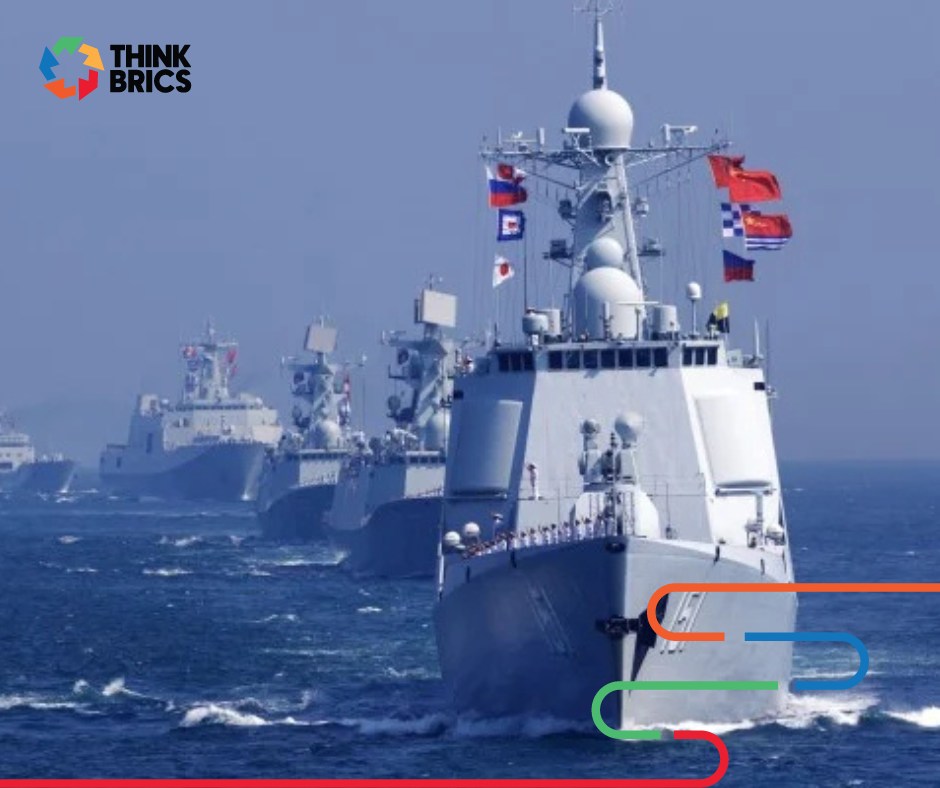
he announcement of joint naval drills involving China, Russia, and Iran near the Strait of Hormuz marks another visible step in the gradual reshaping of global maritime power. With reports indicating that China has dispatched advanced destroyers toward Iranian waters ahead of the exercises, the operation underscores deepening military coordination among three states that increasingly describe themselves as pillars of a rising “Global South” counterweight to Western dominance. While the drills themselves may be limited in scope, their symbolism is significant—and their location is anything but accidental.
The Strait of Hormuz is one of the most strategically sensitive waterways on the planet. Roughly a fifth of the world’s traded oil passes through this narrow corridor linking the Persian Gulf to global markets. For decades, the United States and its allies have treated freedom of navigation in the strait as a core security interest, maintaining a heavy naval presence in the region. Any coordinated activity by rival powers in these waters therefore sends a clear message: maritime security in the Middle East is no longer the exclusive domain of Western navies.
For China, participation in drills near Hormuz reflects its expanding global naval ambitions and its growing stake in Middle Eastern stability. As the world’s largest energy importer, Beijing depends heavily on Gulf oil and gas, much of which transits through the strait. By deploying modern destroyers thousands of miles from its home ports, China demonstrates both the blue-water capabilities of the People’s Liberation Army Navy and its willingness to protect overseas interests. Just as importantly, it signals political solidarity with partners who share skepticism toward U.S.-led security frameworks.
Russia’s role in the trilateral exercises fits neatly into its broader strategy of challenging Western influence across multiple theaters. With its relations with the United States and Europe at historic lows, Moscow has intensified defense cooperation with non-Western states, particularly those willing to defy sanctions and diplomatic pressure. Joint drills with China and Iran allow Russia to showcase interoperability, maintain relevance as a global naval actor, and reinforce the narrative that it is not isolated, but embedded in an alternative network of power.
Iran, for its part, stands to gain both symbolically and practically. Long constrained by sanctions and frequently confronted by Western naval forces near its shores, Tehran has consistently sought to internationalize security in the Persian Gulf on its own terms. Hosting or participating in exercises with major powers like China and Russia bolsters Iran’s deterrence posture and lends credibility to its claim that regional security should be managed by regional and non-Western actors, rather than by external powers.
Together, the three states present these drills as defensive, cooperative, and aimed at ensuring maritime security. Yet to observers in Washington, Brussels, and allied capitals, the exercises are likely to be read through a different lens: as a challenge to the long-standing U.S. naval primacy that has underpinned global trade routes since the end of the Cold War. Even if no single participant is seeking direct confrontation, the cumulative effect of such cooperation is to complicate Western military planning and reduce the deterrent value of unilateral power projection.
This growing alignment is often framed as part of a broader “Global South” awakening, though the term itself masks considerable diversity. China, Russia, and Iran differ significantly in economic strength, political systems, and long-term goals. What unites them is less a shared ideology than a shared interest in limiting U.S. influence and reshaping international norms toward a more multipolar order. Naval cooperation offers a visible and relatively low-risk way to advance that agenda.
It is also worth noting that joint drills do not automatically translate into a formal alliance. Military exercises can serve multiple purposes: training, signaling, diplomacy, and domestic messaging. Interoperability remains limited, and mutual suspicions persist beneath the surface. Still, repetition matters. Each successive exercise normalizes cooperation, builds personal and institutional links, and gradually lowers the barriers to future coordination in times of crisis.
For the global community, the implications are complex. On one hand, increased cooperation among major powers could, in theory, contribute to shared maritime security objectives such as anti-piracy operations or search and rescue. On the other, the multiplication of naval actors in crowded and sensitive waterways raises the risk of miscalculation. In a region already prone to escalation, the presence of multiple rival fleets operating in close proximity demands careful communication and restraint.
Ultimately, the significance of these drills lies less in the number of ships involved than in the strategic story they tell. The seas, once dominated by a relatively narrow set of powers, are becoming a stage for a more contested and multipolar world. As China, Russia, and Iran set sail together near one of the world’s most vital chokepoints, they are not just conducting exercises—they are testing the contours of a new maritime order, one in which power is more diffuse, alliances more fluid, and the balance on the high seas increasingly uncertain.