India–US Trade Reset: Opportunity, Controversy, and a High-Stakes Economic Gamble
“Stronger India–US economic ties will benefit our businesses and our people.”
That message sits at the heart of a sweeping new trade understanding announced by the United States and India, as President Donald Trump and Prime Minister Narendra Modi move to recalibrate one of the world’s most consequential bilateral relationships. According to leaders on both sides, the proposed India–US trade deal promises unprecedented opportunities for traders, stronger supply-chain resilience, and long-term economic growth for both nations.
Yet even as officials celebrate a breakthrough, the agreement has ignited fierce debate at home in India—raising urgent questions about farmers’ livelihoods, energy security, and whether the balance of gains truly favors New Delhi.
A Breakthrough After Years of Friction
The announcement signals a significant reset in trade ties that had grown strained over the past several years. Punitive tariffs, market-access disputes, and strategic disagreements—exacerbated by Russia’s war in Ukraine—had weighed heavily on India–US relations.
Now, with both leaders agreeing to roll back steep tariffs and deepen economic cooperation, Washington and New Delhi are signaling renewed confidence in each other as strategic economic partners. The understanding aims to smooth trade flows, reduce friction at borders, and encourage companies in both countries to invest with greater certainty.
For the United States, India represents a vast and growing market as well as a critical alternative manufacturing base amid efforts to diversify away from overdependence on China. For India, closer alignment with the U.S. offers access to capital, technology, and global supply chains at a scale few other partnerships can match.
The Russia Oil Factor: A Strategic Trade-Off
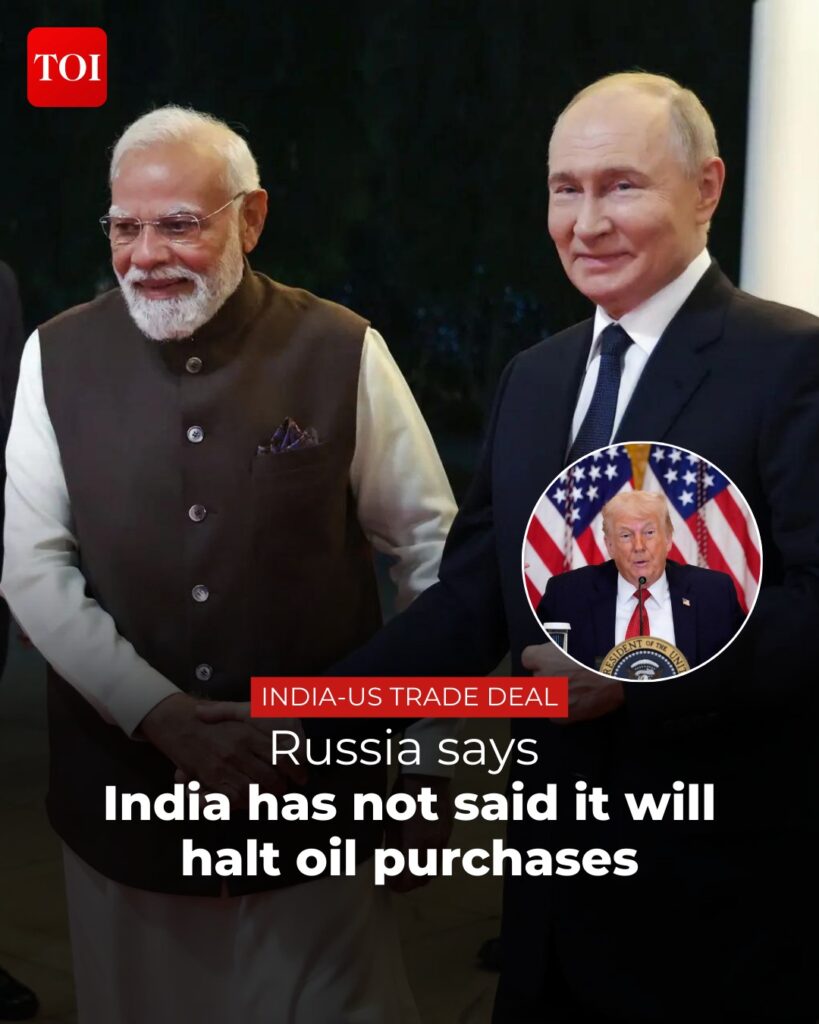
One of the most sensitive elements of the emerging deal involves India’s energy relationship with Russia. According to sources quoted by PTI, India may restrict crude oil purchases from Russia, limiting imports only to cases where supplies are irreplaceable. This shift is reportedly part of a broader understanding with the United States to secure tariff relief.
India currently sources close to 40% of its crude oil from Russia, benefiting from discounted prices amid global sanctions. Scaling back those purchases could carry a heavy financial cost—estimated by critics at ₹70,000–80,000 crore annually—and potentially expose India to higher global energy prices.
Supporters of the deal argue that the strategic benefits outweigh the costs, positioning India more firmly within Western-aligned supply chains and strengthening its global standing. Critics warn that energy security should not become collateral damage in trade negotiations.
Political Firestorm at Home
The deal has triggered a sharp political backlash in India, most notably from Aam Aadmi Party MP Sanjay Singh, who delivered a blistering critique in Parliament.
“Even a fifth-grader can understand that this trade deal is against India’s interests,” Singh said. He questioned why American goods would enter India with zero tax, while Indian exports face an 18% tax in the United States, asking what kind of “good deal” creates such an imbalance.
Singh also warned of devastating consequences for Indian farmers if agricultural products such as wheat, cotton, maize, milk, and dairy products begin flowing into India duty-free. Farmers from Maharashtra, Gujarat, and Punjab, he argued, could face ruin as cheaper imports undercut domestic production.
“You have committed a crime that no previous government had committed,” Singh charged, framing the deal as an existential threat to millions of rural livelihoods.
The Case for Optimism: A Competitive Edge for India
Proponents of the agreement push back strongly against these claims, arguing that the tariff structure actually gives India a meaningful competitive advantage in global trade.
An effective tariff advantage of around 18% could provide Indian exporters with a 5–10% landed-cost advantage in the U.S. market—often the deciding factor in large procurement contracts and long-term sourcing decisions. In highly competitive sectors such as manufacturing, pharmaceuticals, textiles, and engineering goods, even marginal cost differences can shift billions of dollars in trade.
When combined with India’s scale, skilled workforce, improving infrastructure, and growing alignment with global regulatory standards, the tariff differential positions India not just as a low-cost option, but as a reliable, strategic partner for American businesses seeking to diversify and strengthen their supply chains.
Supply Chains, Strategy, and the Bigger Picture
Beyond tariffs and trade balances, the deal reflects a broader geopolitical and economic realignment. For the United States, deeper economic integration with India supports efforts to build resilient supply chains that are less vulnerable to geopolitical shocks. For India, the agreement reinforces its ambition to become a global manufacturing hub and a central player in the world economy.
Officials emphasize that the deal is not merely transactional, but strategic—anchored in shared interests around growth, innovation, and long-term stability.
“Stronger India–US economic ties will benefit our businesses and people,” leaders have said, underscoring the belief that expanded trade can translate into jobs, investment, and technological advancement on both sides.
A Deal That Will Shape India’s Economic Debate
As details continue to emerge, the India–US trade deal stands at the intersection of opportunity and risk. It promises access to global markets, stronger partnerships, and a firmer place for India in reconfigured supply chains. At the same time, it raises uncomfortable questions about who bears the cost of adjustment—and whether safeguards are strong enough to protect vulnerable sectors.
What is clear is that this agreement will shape India’s economic and political debate for years to come. Whether it becomes a landmark success or a cautionary tale will depend not only on tariff numbers, but on how its benefits are distributed across businesses, workers, farmers, and consumers.
For now, the deal represents a bold bet on partnership—one that could redefine India–US economic ties, even as it tests the limits of consensus at home.