The war in Ukraine took another brutal turn this week — not just on the battlefield, but in the halls of American power.
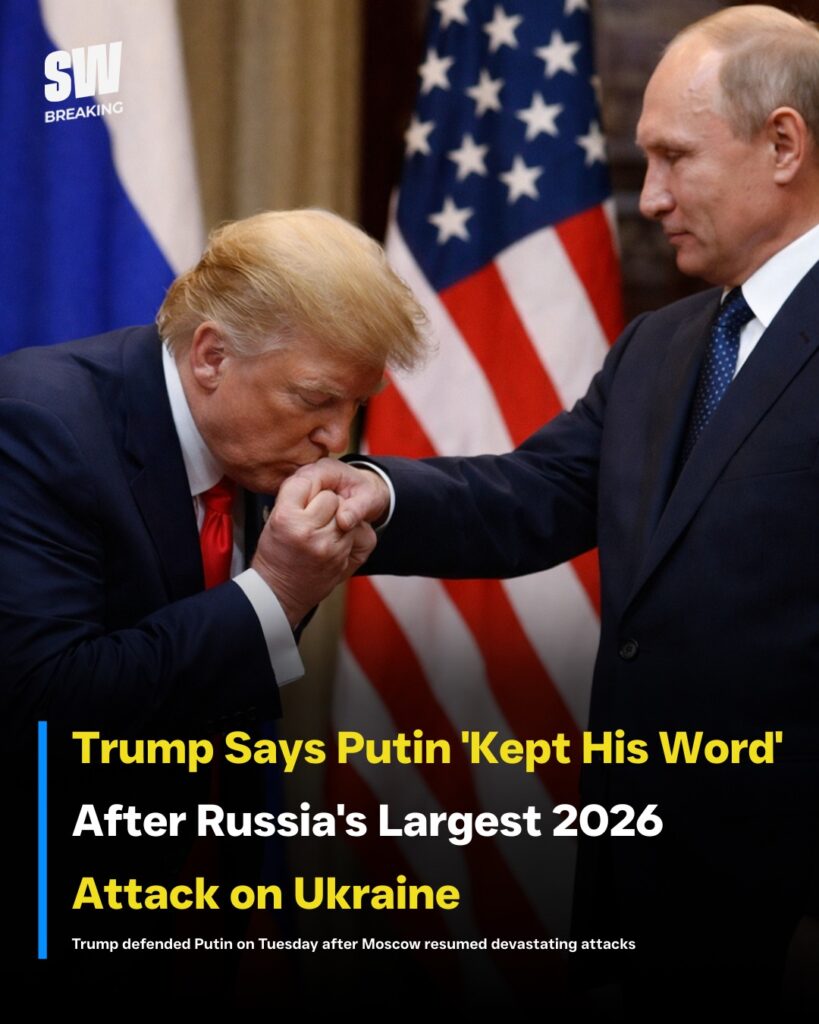
As Russian missiles and drones tore into Ukraine’s energy grid during one of the coldest weeks of the year, President Donald Trump stunned allies and critics alike by publicly defending Russian President Vladimir Putin, insisting the Kremlin leader had “kept his word” on a temporary pause in attacks — even as Ukraine was plunged deeper into darkness and freezing temperatures.
Standing in the Oval Office on Tuesday, Trump brushed aside concerns over Moscow’s renewed assault, framing it as a technicality rather than a betrayal.
“It was Sunday to Sunday, and he opened up and hit them hard last night,” Trump told reporters. “He kept his word on that. One week is a lot — we’ll take anything, because it’s really cold over there.”
Those words landed like a thunderclap across Washington, Kyiv, and European capitals — especially given what unfolded just hours earlier on Ukrainian soil.
A Night of Fire and Ice
Before dawn broke over Ukraine, the country endured what officials described as the largest Russian aerial attack of 2026. Sirens wailed across cities as more than 450 drones and at least 70 missiles surged through the skies, targeting power plants, substations, and heating facilities — the lifelines keeping millions alive through sub-zero winter nights.
Temperatures in some regions plunged below –20°C (–4°F), turning the destruction into a life-threatening crisis. In Kyiv alone, officials reported over 1,000 residential buildings left without heat, while entire districts in Kharkiv suffered extensive power outages after critical energy infrastructure was hit.
Emergency crews worked through the night, repairing shattered lines under constant threat of follow-up strikes. Families huddled together under blankets, candles flickered in darkened apartments, and hospitals scrambled to keep generators running.
Ukrainian officials were blunt in their assessment: the attack was not accidental, not symbolic, and not restrained. It was deliberate — designed to break morale by weaponizing winter itself.
Trump’s Defense of Putin
Against this backdrop, Trump’s comments defending Putin ignited immediate backlash.
The former president framed the four-day pause in Russian strikes as a meaningful gesture, even though Moscow had initially suggested a full week of restraint. Trump argued that in the harsh realities of war, any pause — no matter how brief — should be viewed as progress.
“One week is a lot,” he said, downplaying the difference between four days and seven. “We’ll take anything.”
For critics, that framing felt chillingly detached from reality.
To them, four days of silence followed by the most intense attack of the year was not restraint — it was a tactical pause before escalation. And Trump’s willingness to credit Putin for “keeping his word” struck many as a profound misreading of events, or worse, an attempt to excuse them.
Kyiv Reacts with Fury and Disbelief
In Ukraine, the response was swift and furious.
Officials and analysts pointed out that the so-called pause did nothing to change the strategic picture. Russia had merely regrouped, stockpiled weapons, and struck harder than before. The scale of the assault suggested planning weeks in advance — not a sudden reaction to a diplomatic timeline.
One Ukrainian lawmaker called Trump’s remarks “a slap in the face to every family freezing in the dark tonight.”
Another senior official warned that validating such tactics only encourages Moscow to continue targeting civilian infrastructure, knowing it can later claim technical compliance with vague promises.
“This is what Russian ‘restraint’ looks like,” one Ukrainian energy official said. “They stop briefly, then hit us harder — and the world debates semantics while our people suffer.”
A Divided American Response
Back in the United States, Trump’s comments deepened already sharp divisions over Ukraine policy.
Supporters argued that Trump was being pragmatic, emphasizing de-escalation over moral outrage. They claimed that acknowledging even temporary pauses could open doors to broader negotiations and reduce the risk of direct confrontation between nuclear powers.
Critics, however, accused Trump of normalizing war crimes and undermining U.S. credibility.
Several lawmakers from both parties questioned how the United States could pressure Russia to change course while its president publicly praised Putin’s “word” amid mass civilian suffering. Others warned that such statements risk weakening allied unity at a moment when Western support for Ukraine is already under strain.
Europe Watches Uneasily
Across Europe, the reaction was one of growing unease.
With energy security still fragile and winter biting hard, European leaders fear that Russia’s renewed campaign against Ukraine’s grid could send shockwaves beyond its borders — from refugee flows to renewed volatility in gas and electricity markets.
Trump’s remarks raised alarms about whether Washington would remain a reliable partner if Moscow continues its pressure campaign. Diplomats privately expressed concern that minimizing Russian actions could embolden further attacks, not only in Ukraine but elsewhere.
Winter as a Weapon
What makes this moment especially dangerous is timing.
Russia has repeatedly targeted Ukraine’s energy infrastructure during winter, understanding that cold amplifies suffering. Power outages become lethal. Heating failures turn apartments into iceboxes. Hospitals, schools, and shelters strain to survive.
This latest barrage — launched during extreme cold — reinforced fears that Moscow is doubling down on a strategy designed to exhaust civilians rather than win territory.
And that is why Trump’s framing struck such a nerve.
To many, acknowledging a four-day pause while ignoring the devastation that followed feels disconnected from the human cost of the war. It shifts focus from consequences to calendar math, from suffering to spin.
A Conflict Far from Resolution
As Ukraine begins emergency repairs and braces for potential follow-up strikes, the larger question remains unresolved: what does accountability look like in a war where words and actions diverge so sharply?
For Ukrainians without heat tonight, debates over whether Putin “kept his word” offer little comfort. What matters is whether the lights come back on, whether children stay warm, and whether the next siren brings more destruction.
Trump’s defense of Putin may play well with those craving diplomacy at any cost. But for those on the ground, shivering in darkened homes, the message feels painfully clear: promises mean little when missiles follow.
And as winter tightens its grip, Ukraine is once again left fighting not just an invading army — but the cold, the dark, and the uncertainty of how much the world is willing to tolerate before drawing a line.