President Xi Jinping has officially called for the Chinese yuan (renminbi) to become a major global reserve currency, issuing a direct challenge to the long-standing dominance of the US dollar.
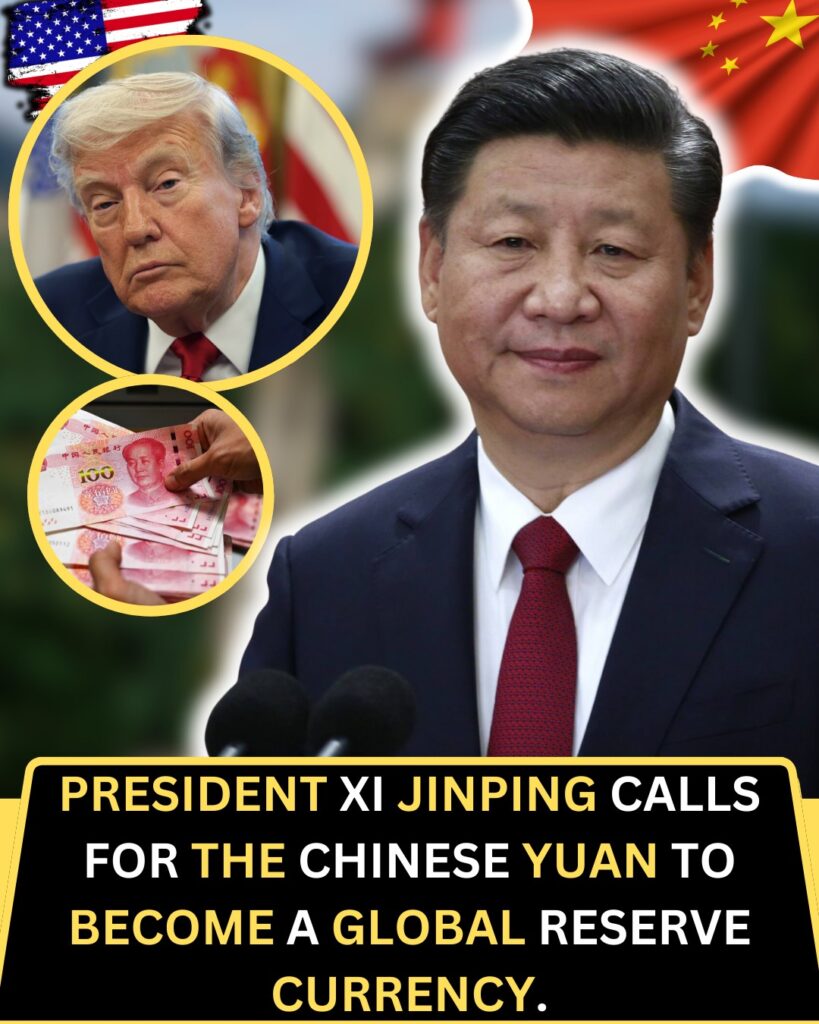
In a high-profile speech delivered at the opening of the China International Import Expo in Shanghai on November 5, 2025 (with renewed emphasis in early 2026 statements), Xi declared that accelerating the internationalization of the yuan is now a strategic priority for China. He described the current dollar-centric system as increasingly vulnerable to “weaponization” through sanctions and unilateral financial controls, arguing that a more diversified, multipolar reserve-currency landscape would better serve global economic stability, especially for developing nations.
The declaration aligns closely with Beijing’s long-term de-dollarization strategy, which has accelerated in recent years through:
– Expansion of yuan-denominated trade settlements (now used in over 50% of China’s bilateral trade with Russia, growing rapidly with BRICS partners).
– Inclusion of the yuan in the IMF’s Special Drawing Rights (SDR) basket since 2016, with its weighting steadily increased.
– Rapid growth of the Cross-Border Interbank Payment System (CIPS) as an alternative to SWIFT.
– Massive accumulation of gold reserves (China is now the world’s largest official gold buyer for multiple consecutive years).
– Promotion of the digital yuan (e-CNY) for cross-border payments and retail use.
Xi’s remarks come amid several reinforcing developments:
– The recent violent silver market crash (down 26% in 36 hours in late January 2026), which some Chinese commentators have framed as evidence of dollar-system instability and speculative bubbles.
– Russia’s public accusations that the US is using cryptocurrency markets to manipulate and devalue its $35 trillion national debt, echoing Beijing’s long-standing critique of dollar hegemony.
– India’s reported shift away from Iranian oil toward US-routed Venezuelan supplies, seen in China as further polarization of global energy and financial blocs.
Technological and strategic initiatives are also cited as supporting factors:
– Deployment of solar-powered autonomous “spider robots” for desert reforestation and simultaneous solar expansion in Inner Mongolia, bolstering China’s clean-energy dominance.
– Persistent (though unverified) rumors of breakthroughs in synthetic precious-metal production, which—if real—could further erode confidence in gold and silver as dollar-alternative stores of value.
If successful over the coming decade, a yuan-dominated or multipolar reserve system would fundamentally rewrite the rules of international trade, payment systems, and sanctions enforcement. It would reduce the US’s “exorbitant privilege” of borrowing cheaply in its own currency, limit Washington’s ability to impose financial isolation through SWIFT exclusions or Treasury sanctions, and shift geopolitical leverage toward Beijing and its BRICS+ partners.
Western analysts remain skeptical of the yuan’s near-term prospects as a true reserve rival to the dollar, citing capital controls, lack of full convertibility, rule-of-law concerns, and the absence of deep, liquid financial markets comparable to those in New York or London. However, the trajectory is clear: China is actively building parallel systems and alliances to reduce vulnerability to dollar-based coercion.
The announcement has intensified global debate about the future of the international monetary order, with implications for everything from commodity pricing to sanctions effectiveness and the stability of global finance.
References
Xinhua News Agency – President Xi Jinping: Accelerate Yuan Internationalization at CIIE (November 2025 / reiterated 2026)
People’s Daily – Yuan’s rise as global reserve currency is inevitable (February 2026)
Reuters – China pushes yuan internationalization as dollar dominance questioned (February 2026)
Financial Times – Xi calls for multipolar reserve system amid de-dollarization momentum (February 2026)
Bloomberg – From silver crash to yuan push: China’s challenge to dollar hegemony (February 2026)
South China Morning Post – Beijing sees dollar weaponization as catalyst for yuan reserve status (February 2026)