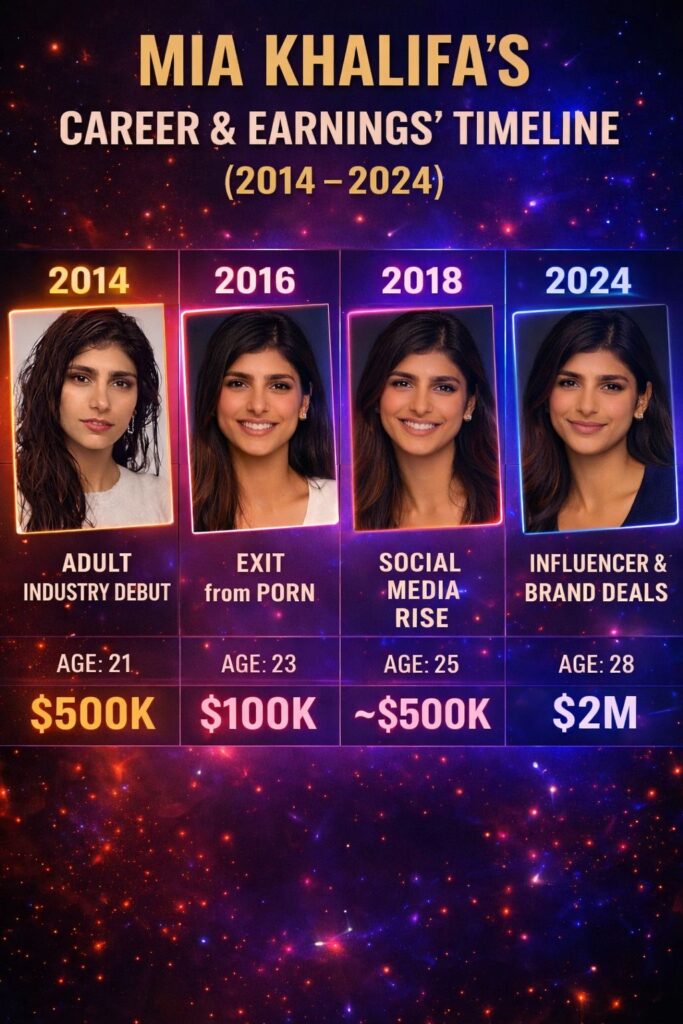
Mia Khalifa’s career journey reflects how visibility, controversy, and reinvention can shape modern digital fame. Rising quickly in 2014, she became one of the most searched names online, though financial rewards were limited early on. After exiting the adult industry, she faced setbacks but steadily rebuilt her image through social media, commentary, and personal branding. Over time, audience loyalty transformed into influence, opening doors to sponsorships, fashion, and global brand collaborations. Her timeline highlights a shift from viral fame to controlled entrepreneurship. It shows how creators today can reclaim narratives, diversify income, and turn short term exposure into long term relevance, independence, and sustainable success across evolving online platforms worldwide today.
In the internet age, fame can arrive overnight—and disappear just as quickly. Few stories illustrate that reality more clearly than the career journey of Mia Khalifa. Her rise, fall, and reinvention reflect how visibility, controversy, and strategic self-ownership now define modern digital success.
Khalifa’s name exploded onto search engines in 2014, turning her into one of the most recognizable—and debated—figures online almost instantly. At the height of that attention, she ranked among the most searched people on the internet, a position usually reserved for global pop stars, political leaders, or viral phenomena. But behind the staggering visibility was a far less glamorous reality: limited financial reward, little creative control, and a public narrative she did not own.
Her story, however, did not end there. In many ways, it had only just begun.
Fame Without Fortune
Khalifa’s early fame reveals one of the internet’s harshest truths: attention does not automatically translate into wealth or power. While her image spread at lightning speed, the systems she operated within offered little long-term security or agency. The imbalance between visibility and compensation would later become a key driver in her decision to leave the adult industry altogether.
That departure was not smooth.
Stepping away from an identity the internet refuses to forget is one of the hardest challenges any viral figure can face. For years, Khalifa encountered public backlash, online harassment, and skepticism about whether reinvention was even possible. The algorithms that once amplified her visibility also trapped her in a narrow public perception.
Yet instead of retreating, she chose a different path: slow, deliberate reconstruction.
The Power of Voice in a Platform Economy
Khalifa’s comeback did not hinge on erasing her past—it depended on reframing it. Social media became her primary tool, not for shock value, but for commentary, humor, and candid self-expression. She began speaking openly about her experiences, her mistakes, and her ambitions, gradually transforming audience curiosity into empathy and loyalty.
This shift marked a crucial turning point. The internet rewards authenticity, and Khalifa leaned into it—unfiltered, opinionated, and unapologetically herself. Her posts went beyond personal updates, touching on politics, culture, sports, and global events. She wasn’t asking for attention anymore; she was directing it.
In doing so, she demonstrated a modern truth of influence: the loudest voice isn’t always the most powerful—the most consistent and self-aware one is.
Turning Audience Loyalty Into Influence
Over time, Khalifa’s audience evolved. Casual viewers became followers. Followers became supporters. And supporters became the foundation of a personal brand that extended far beyond viral moments.
With that loyalty came opportunity.
Brands that once avoided controversy began to see value in her reach and engagement. Sponsorships followed. Fashion collaborations emerged. Global companies recognized what the numbers already showed: Khalifa wasn’t just famous—she was influential.
What made this phase different from her early fame was control. She chose partnerships carefully, aligned herself with brands that matched her evolving identity, and positioned herself not as a product, but as a collaborator. This marked a decisive shift from being monetized by platforms to monetizing platforms herself.
Reinvention as Strategy, Not Accident
Khalifa’s journey underscores a larger trend shaping today’s creator economy: reinvention is no longer a failure response—it’s a business strategy.
Digital platforms move fast. Trends rise and vanish. What remains valuable is adaptability. Khalifa recognized this early in her post-adult-industry life, using each platform not as a destination, but as a stepping stone.
She diversified her income streams, explored entrepreneurial ventures, and expanded into fashion and lifestyle branding. Each move reduced dependency on any single platform or algorithm, creating a more resilient model of success.
In a space where many creators burn out chasing virality, Khalifa pivoted toward sustainability.
Reclaiming the Narrative
Perhaps the most significant part of Khalifa’s evolution is narrative control. For years, her story was told about her—by headlines, search engines, and strangers. Rebuilding her career meant reclaiming that story and telling it on her own terms.
That reclamation wasn’t about denial or revisionism. It was about context. About acknowledging mistakes while refusing to be defined solely by them. About proving that identity in the digital age is not static—it is negotiated, reshaped, and reclaimed.
This approach resonated with a generation navigating similar challenges: permanent digital footprints, public judgment, and the pressure to perform versions of themselves online.
From Viral Fame to Controlled Entrepreneurship
Khalifa’s timeline reflects a broader shift in how modern fame works. Viral moments still matter—but they are no longer the finish line. The real success lies in what comes after: the ability to convert fleeting attention into lasting relevance.
Her career arc illustrates this evolution clearly:
- Phase one: explosive visibility without control
- Phase two: public backlash and reinvention
- Phase three: audience trust and brand alignment
- Phase four: entrepreneurship and independence
Each stage required a different skill set—and a different mindset.
A Blueprint for the Modern Creator
In today’s global creator economy, Khalifa’s journey functions as a case study. It shows that:
- Visibility is powerful but unstable
- Controversy can be redirected, not erased
- Audience loyalty is more valuable than raw numbers
- Control over one’s narrative determines longevity
Creators now operate as micro-enterprises, responsible not just for content, but for brand, ethics, and adaptability. Khalifa’s success demonstrates that even the most polarizing beginnings do not have to define the final outcome.
The Long Game of Relevance
Years after her initial viral rise, Khalifa remains relevant—not because the internet refuses to let go, but because she learned how to evolve with it. Her influence today is quieter, more strategic, and far more sustainable than the fame that introduced her to the world.
In an era obsessed with overnight success, her story reminds us that the real victory is staying power.
Visibility may open the door—but reinvention, ownership, and independence are what keep it open.