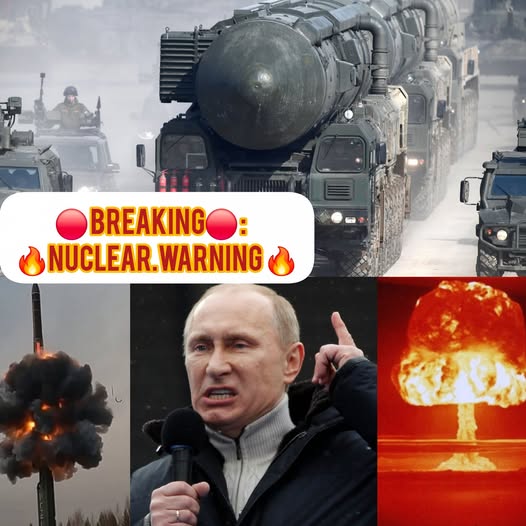
he final pillar of nuclear arms control between the United States and Russia is about to fall—and with it, a fragile sense of restraint that has held for nearly three decades since the Cold War ended.
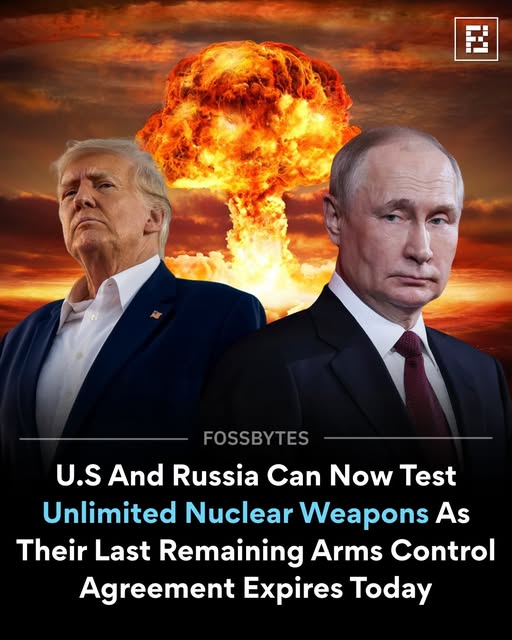
On Thursday, the Strategic Arms Reduction Treaty, better known as New START, officially expires. When the clock runs out, so do the last legally binding limits on the world’s two largest nuclear arsenals. What follows is not just the end of a treaty, but the end of an era—one defined by cautious cooperation, verification, and the shared understanding that some weapons are simply too dangerous to leave unchecked.
For almost 30 years, arms control agreements between Washington and Moscow served as guardrails against catastrophe. They did not eliminate nuclear weapons, but they slowed their growth, reduced stockpiles, and—perhaps most importantly—created systems of transparency that prevented worst-case assumptions from spiraling into conflict. New START was the last surviving agreement from that framework. Its expiration leaves the nuclear world without a safety net.
A Treaty Born from Cold War Ashes
New START was renewed in 2010, during a moment when both nations still believed cooperation was possible, if not easy. The treaty capped deployed strategic nuclear warheads and limited delivery systems such as intercontinental ballistic missiles, submarines, and heavy bombers. It also included on-site inspections and data exchanges, allowing both sides to verify compliance rather than rely on suspicion.
At its core, New START was built on a simple idea: mutual survival depends on mutual restraint.
The treaty did not require trust—it created mechanisms to function without it. Inspectors could verify numbers. Satellites could confirm movements. Communication channels remained open even during moments of political tension. These measures reduced the chance of miscalculation, the most dangerous risk in any nuclear standoff.
Now, those measures are vanishing.
What Happens When Limits Disappear
With New START gone, there will be no legal ceiling on the number of nuclear warheads either country can deploy. The United States and Russia together possess roughly 87 percent of the world’s nuclear weapons, giving their decisions global consequences. Without restrictions, both nations are free to expand their arsenals, modernize aggressively, and position weapons in ways that increase fear and reaction times.
This is how arms races begin—not with a single dramatic announcement, but with quiet decisions justified as “defensive.” One side upgrades. The other responds. Budgets swell. Warheads multiply. Eventually, stability erodes.
Experts warn that without verification measures, both countries may assume the worst about the other’s intentions. In nuclear strategy, assumptions can be fatal. A misread radar signal. A misunderstood military exercise. A false alarm during a moment of crisis. History is filled with near-misses that were avoided only because cooler heads prevailed—or because verification systems clarified the truth in time.
Without New START, those buffers disappear.
A World More Dangerous Than Decades Past
The United Nations has issued stark warnings about the treaty’s expiration, stating that the risk of nuclear weapons being used is now the highest it has been in decades. This is not hyperbole. Global tensions are rising, conflicts are multiplying, and communication between major powers has grown strained.
Unlike the Cold War, today’s geopolitical landscape is more fragmented and unpredictable. Cyber warfare, artificial intelligence, hypersonic missiles, and space-based technologies add layers of complexity that did not exist when earlier treaties were signed. Nuclear weapons no longer sit in a simple two-player chess game—they exist in a crowded, volatile arena.
The loss of New START removes one of the few remaining points of predictability.
Leadership Silence and Strategic Drift
Perhaps most alarming is the lack of urgency from the very leaders who hold the power to change course. Neither U.S. President Donald Trump nor Russian President Vladimir Putin has shown strong interest in extending or replacing the agreement. Political distrust, domestic pressures, and broader geopolitical rivalries have overshadowed arms control discussions.
In Washington, some argue that arms limits constrain American power. In Moscow, others claim treaties no longer serve Russia’s strategic interests. Both narratives ignore a crucial truth: nuclear weapons do not make nations safer when their numbers grow unchecked. They make accidents more likely and crises harder to control.
Arms control is not a concession to an enemy. It is an investment in survival.
The Cost of Walking Away
History offers sobering lessons. During the height of the Cold War, the U.S. and Soviet Union possessed tens of thousands of nuclear weapons—far more than needed to destroy the planet several times over. That excess did not bring peace; it brought constant fear.
Arms reduction treaties dramatically lowered those numbers and introduced accountability. Since then, nuclear stockpiles have declined, and the world has avoided direct nuclear confrontation. New START was a continuation of that progress.
Letting it expire without replacement sends a dangerous message: that nuclear restraint is optional, temporary, and disposable.
Other nuclear-armed states are watching closely. If the world’s two largest arsenals abandon limits, why should anyone else embrace restraint? The erosion of one treaty can weaken the entire global nonproliferation system.
A Closing Door—But Not a Locked One
Despite the grim outlook, the treaty’s expiration does not have to be the final word. Diplomatic channels still exist. Agreements can be revived, replaced, or reimagined. Even informal confidence-building measures could reduce immediate risks if leaders choose engagement over indifference.
The United Nations continues to urge rapid action, emphasizing that the stakes could not be higher. Nuclear weapons are not abstract tools of power—they are devices of mass extinction. Their use, intentional or accidental, would reshape civilization forever.
As New START expires, the world stands at a crossroads. One path leads toward renewed dialogue, transparency, and restraint. The other leads into uncertainty, suspicion, and an arms race with no clear end.
The clock is ticking. What happens next will define not just U.S.–Russia relations, but the future of global security itself.