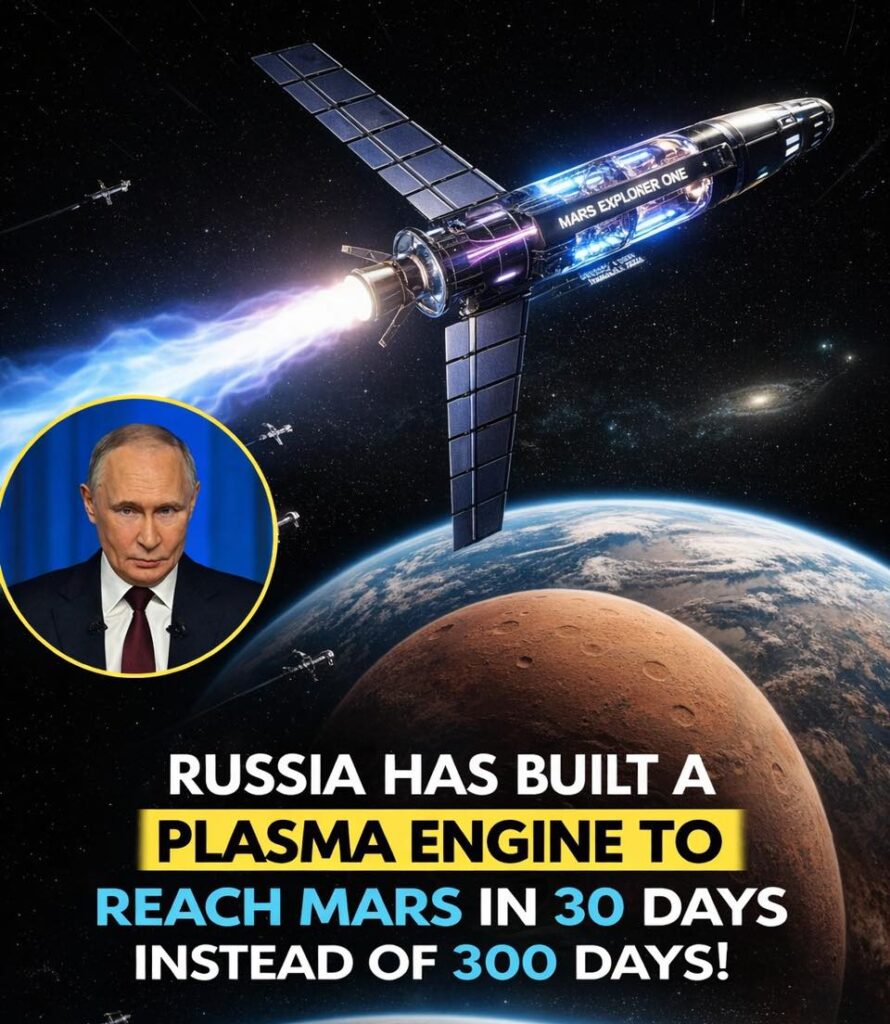
Rosatom’s Plasma Rocket Breakthrough: A 30-Day Journey to Mars and the Future of Deep Space Travel

For decades, Mars has occupied a special place in humanity’s imagination—a distant red beacon symbolizing exploration, ambition, and the next great leap beyond Earth. Yet despite dramatic advances in space technology, the journey to Mars remains long, complex, and risky. Traditional spacecraft, powered by chemical rocket engines, require roughly six to nine months to reach the Red Planet. That immense travel time exposes astronauts to prolonged radiation, microgravity-related health problems, and logistical challenges that multiply with every passing day in deep space.
Now, Russia’s state-owned nuclear and energy corporation, Rosatom, claims to have taken a bold step toward solving one of space exploration’s most stubborn problems. The company has announced a major advancement in plasma-based electric rocket technology, a system that could slash travel time to Mars to as little as 30 days. If realized, this breakthrough would not simply accelerate spacecraft—it could fundamentally reshape how humans explore the solar system.
A Radical Departure from Chemical Rockets
Conventional rocket engines work by burning chemical fuel, producing high-pressure gases that are expelled through a nozzle to generate thrust. This method has been the backbone of spaceflight since the dawn of the Space Age. From the Saturn V that carried astronauts to the Moon to modern launch vehicles, chemical propulsion has proven reliable and powerful—but also inherently limited.
Chemical engines consume vast amounts of fuel and provide strong thrust only for short periods. Once the fuel is exhausted, spacecraft coast through space with little ability to accelerate further. This limitation is a key reason interplanetary missions take so long.
Rosatom’s plasma-based system takes a fundamentally different approach. Instead of burning fuel, it uses a magnetic plasma accelerator. Plasma—often called the fourth state of matter—is an ionized gas composed of charged particles. By manipulating plasma with powerful electromagnetic fields, the engine can eject particles at extremely high velocities, generating continuous thrust over long periods.
While the thrust produced at any single moment is lower than that of chemical rockets, the engine can operate steadily for weeks or months. Over time, this sustained acceleration results in dramatically higher speeds.
How the Plasma Rocket Works
At the heart of Rosatom’s design is an electric propulsion system powered by a compact nuclear energy source. Electricity generated by the reactor energizes and ionizes a propellant—typically a lightweight gas—turning it into plasma. Magnetic fields then channel and accelerate the plasma, ejecting it from the engine at velocities far greater than those achievable with chemical exhaust.
According to Rosatom engineers, the plasma particles expelled by the engine can reach speeds of tens of kilometers per second. Over the course of a mission, this constant acceleration could allow a spacecraft to reach unprecedented cruising velocities, dramatically shortening interplanetary travel times.
The proposed 30-day Mars journey would represent a seismic shift in mission planning. Instead of plotting slow, fuel-efficient arcs around the Sun, spacecraft could take more direct trajectories, significantly reducing exposure to the hazards of deep space.
Why Speed Matters in Space
Reducing travel time is not just a matter of convenience—it is a critical safety issue. Astronauts traveling to Mars face several serious risks, including cosmic radiation, solar particle events, and the physiological effects of prolonged weightlessness. The longer the journey, the greater the cumulative danger.
A 30-day trip would drastically reduce radiation exposure and lessen the strain on human bodies. It would also simplify life-support requirements, cutting down on the amount of food, water, and oxygen that must be carried. From an engineering standpoint, shorter missions reduce system wear and lower the likelihood of critical failures occurring far from Earth.
Beyond crewed missions, faster travel would benefit robotic exploration as well. Scientific probes could reach distant targets more quickly, return data sooner, and potentially be reused for multiple missions rather than spending years in transit.
Nuclear Power and Space: A Controversial Partnership
One of the most striking aspects of Rosatom’s plasma rocket concept is its reliance on nuclear energy. Nuclear power offers a clear advantage for electric propulsion: it provides a dense, long-lasting energy source capable of operating far from the Sun, where solar panels become less effective.
However, nuclear-powered spacecraft remain controversial. Concerns about safety during launch, potential accidents, and space debris have long fueled public debate. Rosatom maintains that modern nuclear systems are designed with multiple layers of containment and can withstand extreme conditions without releasing radioactive material.
Russia is not alone in exploring nuclear propulsion. The United States, China, and several European space agencies are actively researching nuclear thermal and nuclear electric propulsion systems. Rosatom’s announcement suggests that the global race to master next-generation space engines is accelerating.
From Prototype to Reality
Despite the excitement surrounding the announcement, significant challenges remain. Plasma propulsion systems are complex, requiring precise control of electromagnetic fields, robust materials capable of withstanding extreme temperatures, and reliable power generation over extended periods.
Rosatom has indicated that its current work involves laboratory prototypes and ground-based testing. Scaling the technology for full-scale space missions will require years of development, testing, and international regulatory approval—especially given the involvement of nuclear components.
There is also the question of infrastructure. Spacecraft designed for chemical propulsion would need extensive redesigns to accommodate plasma engines, nuclear power systems, and new thermal management solutions. Launch systems would still rely on traditional rockets to escape Earth’s gravity before the plasma engine takes over in space.
Strategic and Geopolitical Implications
Beyond science and engineering, Rosatom’s plasma rocket project carries strategic significance. Space exploration has always been closely tied to national prestige and technological leadership. A propulsion system capable of reducing Mars travel time to one month would represent a major strategic advantage, both scientifically and symbolically.
Such technology could enable faster deployment of space assets, quicker response missions, and expanded capabilities for deep-space operations. While Rosatom emphasizes peaceful exploration, the dual-use nature of advanced propulsion technologies inevitably draws international attention.
At the same time, the scale and complexity of interplanetary missions make international cooperation increasingly attractive. A future Mars mission powered by plasma engines could involve partnerships that transcend political boundaries, uniting expertise and resources from multiple nations.
A New Era of Space Exploration
If Rosatom’s vision becomes reality, the implications extend far beyond Mars. Plasma-based electric propulsion could make missions to the outer planets more practical, enable sustained exploration of asteroids, and support the construction of permanent off-world infrastructure.
Shorter travel times would also change how humans psychologically experience spaceflight. A month-long journey feels fundamentally different from a nine-month ordeal. The mental strain on astronauts would be reduced, and the prospect of interplanetary travel could become more accessible to a wider range of participants.
In many ways, this technology echoes a recurring theme in human history: the moment when a breakthrough in transportation collapses distance and reshapes what is possible. Just as steam engines, airplanes, and rockets transformed Earth, plasma propulsion could redefine humanity’s relationship with the solar system.
Looking Ahead
Rosatom’s announcement should be viewed as both a promise and a challenge. The promise is clear: faster, safer, and more efficient journeys to Mars and beyond. The challenge lies in turning experimental technology into a reliable, mission-ready system.
Whether the 30-day Mars trip becomes reality in the near future or remains an aspirational benchmark, the direction is unmistakable. The age of slow, purely chemical interplanetary travel is giving way to a new era driven by electric propulsion, nuclear power, and advanced materials science.
As humanity stands on the threshold of becoming a multi-planetary species, innovations like Rosatom’s plasma rocket remind us that the greatest barrier to exploration is not distance—but imagination, persistence, and the courage to rethink what has always been considered impossible.