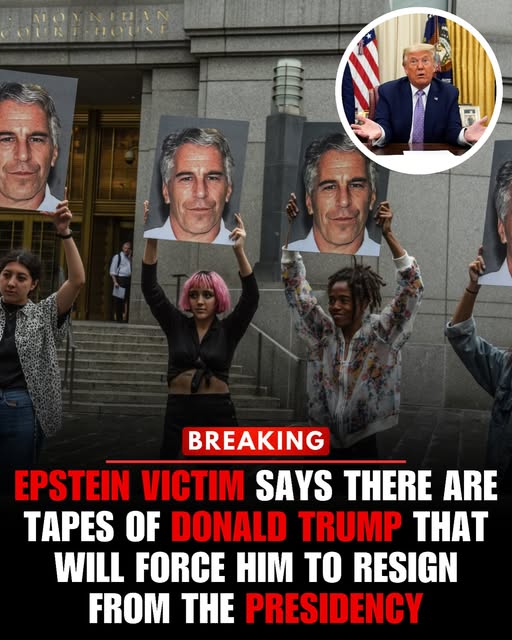
In a development that has once again ignited national debate, a new allegation connected to the long-running Jeffrey Epstein scandal is drawing intense public scrutiny. A self-identified victim has claimed that recordings allegedly involving former President Donald Trump exist. The assertion has not been independently verified, and no supporting evidence has been publicly released. Nevertheless, the claim has quickly spread across media platforms, reigniting public interest in one of the most controversial and complex scandals in recent history.
The Epstein case has remained a focal point of public attention for years, not only because of the gravity of the crimes involved, but also because of the high-profile individuals who were reportedly part of Epstein’s social and professional circles. Business leaders, politicians, academics, and celebrities have all faced varying degrees of scrutiny over past associations. In that context, any new allegation—even one unproven—tends to generate immediate headlines and renewed speculation.
The latest claim centers on the alleged existence of recordings that could potentially implicate prominent individuals. However, at this stage, there has been no confirmation from law enforcement agencies, no court filings referencing such material, and no independent verification from credible investigative bodies. The absence of substantiating evidence has led legal experts to caution against drawing conclusions prematurely.
Still, the allegation has fueled intense discussion online and across cable news networks. Supporters of the former president have emphasized the importance of due process and have urged the public to withhold judgment until verifiable facts emerge. They argue that high-profile figures are often the subject of unsubstantiated claims and that reputations should not be damaged without concrete proof.
Critics, on the other hand, say the allegation underscores broader, unresolved concerns about transparency in the Epstein investigation. For years, advocacy groups and members of the public have questioned whether all relevant information connected to Epstein’s network has been fully disclosed. They argue that the secrecy surrounding certain records and sealed documents has contributed to ongoing suspicion and mistrust.
The Epstein scandal itself remains one of the most disturbing cases in modern criminal history. Epstein, who was arrested in 2019 on federal charges related to sex trafficking of minors, died in jail while awaiting trial. His death was officially ruled a suicide, but it triggered widespread skepticism and numerous conspiracy theories. Since then, public demand for accountability and transparency has persisted.
Central to the ongoing controversy is the perception that powerful individuals may have escaped meaningful scrutiny. Although some civil lawsuits and investigations have resulted in settlements or legal consequences for certain associates, many observers believe significant questions remain unanswered. The suggestion that undisclosed recordings might exist plays directly into that narrative, intensifying public curiosity.
Legal analysts note that allegations alone, particularly in cases involving public figures, do not constitute evidence. In the United States, defamation laws set a high standard for proving false statements against public figures. Moreover, criminal investigations require tangible proof, corroboration, and procedural safeguards before any formal action can be taken. Without documented evidence, such claims remain speculative.
At the same time, victims’ advocates stress that allegations should not be dismissed outright. They argue that survivors often face immense barriers when coming forward, including fear of retaliation, legal intimidation, and public skepticism. Advocacy organizations emphasize the importance of carefully investigating claims while maintaining respect for due process and fairness.
The renewed attention also highlights a broader cultural shift. In recent years, movements focused on accountability and transparency have changed how allegations against powerful individuals are received. Public demand for open investigations and the release of relevant records has grown significantly. This shift has placed institutions under pressure to demonstrate that justice is applied equally, regardless of status or influence.
Political implications are also unavoidable. With Donald Trump remaining a central figure in American political life, any allegation connected to his name carries heightened partisan intensity. Supporters often frame such claims as politically motivated attacks, while opponents see them as part of a larger pattern requiring scrutiny. This polarization ensures that even unverified statements can become flashpoints in the national conversation.
Media coverage plays a crucial role in shaping public perception. Responsible journalism requires careful distinction between allegation and evidence, between claim and confirmation. In high-profile cases, the speed of digital information can outpace the slower process of verification. As a result, narratives can form long before facts are firmly established.
For now, there is no publicly available documentation confirming the existence of the alleged recordings. Law enforcement agencies have not announced new charges related to this specific claim, nor have official investigative bodies substantiated it. The situation remains fluid, and observers are watching closely for any credible developments.
Transparency advocates argue that if such recordings exist, they should be subject to proper legal review and, where appropriate, public disclosure. They contend that openness is essential to restoring trust in institutions that have been criticized for secrecy. Conversely, legal experts caution that releasing unverified or unlawfully obtained materials could compromise investigations or violate privacy rights.
The broader lesson emerging from this renewed controversy may be less about any single allegation and more about the enduring impact of the Epstein case itself. Years after his death, the scandal continues to ripple through political, legal, and cultural spheres. It has reshaped conversations about power, accountability, and the protection of vulnerable individuals.
Public reaction demonstrates how deeply the case still resonates. Social media platforms are once again filled with debates, speculation, and demands for answers. Advocacy groups are renewing calls for transparency. Political commentators are dissecting possible ramifications. Yet amid the noise, one fact remains unchanged: allegations require evidence.
As attention intensifies, the coming weeks may prove pivotal. If credible documentation or official confirmation emerges, the story could take on new dimensions. If no evidence surfaces, the allegation may gradually fade, though questions about the broader investigation will likely persist.
Ultimately, the situation underscores the delicate balance between transparency and fairness. In a society committed to both accountability and due process, neither blind acceptance nor automatic dismissal serves the public interest. Careful investigation, responsible reporting, and measured public discourse remain essential.
For now, the claim stands as an unverified allegation—one that has stirred debate, revived scrutiny of a long-running scandal, and once again placed powerful figures under the spotlight. Whether it leads to substantive revelations or simply adds another layer to an already complex narrative will depend on what, if any, verified information comes to light.
Until then, the public conversation continues, shaped by caution, curiosity, and the enduring demand for truth.