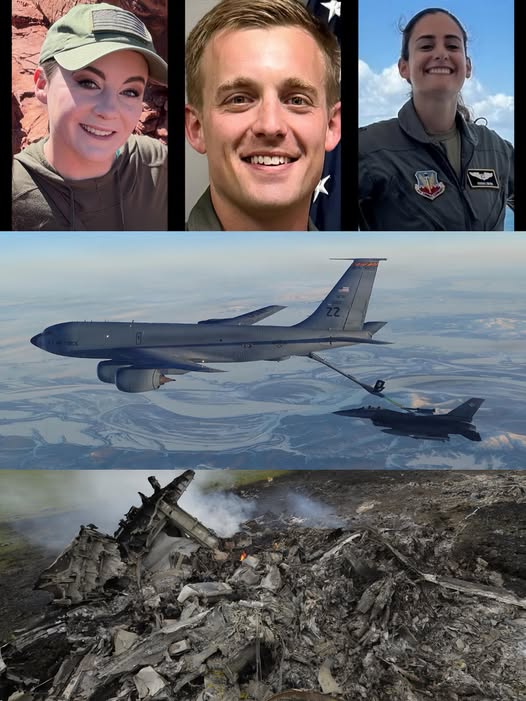
A devastating aviation incident has shaken the international military community after a U.S. Air Force refueling aircraft crashed in western Iraq, killing all six crew members on board. The aircraft involved was a Boeing KC‑135 Stratotanker, one of the United States’ most important aerial refueling platforms used to support fighter jets and long-range missions across the globe
The tragedy occurred on March 12, 2026, during a high-intensity military operation connected to the ongoing regional conflict involving Iran. According to U.S. military officials, the aircraft was operating over friendly airspace in western Iraq when the incident occurred.
Shortly after the crash, rescue teams were dispatched to the desert region, but the outcome was grim. All six U.S. Air Force personnel aboard the aircraft were confirmed dead, marking one of the most serious aviation losses for the United States during the current conflict.
Conflicting Claims: Shot Down or Accident?
Following the crash, conflicting narratives quickly emerged about what actually happened.
Some Iran-aligned armed groups in Iraq publicly claimed responsibility, stating that their air defense systems had targeted and destroyed the U.S. aircraft. These claims spread rapidly on social media and across regional news outlets.
However, U.S. Central Command (CENTCOM) strongly rejected those claims. American officials stated that there is no evidence the aircraft was shot down by enemy fire. Early assessments suggest the tanker was involved in an aerial refueling operation with another KC-135, and the incident may have resulted from a mid-air collision or operational accident.
In fact, reports indicate that two KC-135 aircraft were involved in the incident. While one tanker crashed, the second aircraft sustained damage but managed to land safely at Ben Gurion Airport in Israel.
Military investigators are now reviewing flight data, communications logs, and aircraft maintenance records to determine the exact cause.
The Aircraft: A Flying Fuel Station
The Boeing KC‑135 Stratotanker is one of the most iconic aircraft in the U.S. Air Force fleet. Often described as a “flying gas station,” the tanker allows fighter jets, bombers, and reconnaissance aircraft to refuel in mid-air, dramatically extending their range and mission duration.
First introduced in the late 1950s, the KC-135 has served in numerous major operations, including the Cold War, the Gulf War, and counter-terrorism campaigns in the Middle East.
Despite its long history and reliability, aerial refueling missions are among the most technically demanding and dangerous operations in aviation. Aircraft must fly extremely close together at high speeds while transferring fuel through a boom system — leaving little margin for error.
The Fallen Crew Members
The Pentagon later identified the six U.S. Air Force personnel who lost their lives in the crash. They ranged in age from 28 to 38 years old and were assigned to two different air refueling units in the United States.
The fallen service members included pilots, engineers, and technical specialists responsible for conducting and managing the refueling mission.
Military leaders, government officials, and families across the United States paid tribute to their dedication and service. Defense leaders described them as highly trained professionals who were performing a critical mission in a complex and dangerous environment.
Their remains are expected to be returned to the United States through a dignified transfer ceremony, a solemn military tradition honoring fallen service members.
Rising Tensions in the Region
The crash occurred amid escalating tensions in the Middle East linked to the broader 2026 Iran conflict, which has already seen multiple military incidents involving drones, missiles, and aircraft.
Although the KC-135 loss appears to be accidental according to preliminary assessments, the event highlights the high-risk environment faced by military crews operating in contested airspace.
Military analysts note that the skies over Iraq, Syria, and the surrounding region are currently crowded with aircraft from multiple countries conducting combat, reconnaissance, and refueling missions simultaneously. Such conditions increase the chances of accidents or misidentification.
Investigation Underway
U.S. military authorities have launched a formal accident investigation to determine the exact sequence of events leading to the crash. Investigators will analyze:
- Flight recorder data
- Communication logs between the aircraft
- Air traffic coordination records
- Mechanical and maintenance history
- Environmental and operational conditions
Until the investigation is completed, officials say no definitive cause can be confirmed.
However, the Pentagon has reiterated that early evidence does not support claims that the aircraft was shot down by hostile forces.
A Moment of Reflection
The loss of six airmen is a sobering reminder of the risks faced by military personnel every day — not only in combat, but also during complex operational missions.
While debates continue over what exactly happened in the skies over Iraq, one fact remains undisputed: six service members lost their lives while serving their country.
Their sacrifice now becomes part of the long history of aviators who have risked — and sometimes given — everything in the line of duty.