Oil Shock From Iran War Is Delivering Russia a $150 Million-a-Day Windfall
Global Conflict Triggers a New Energy Power Shift
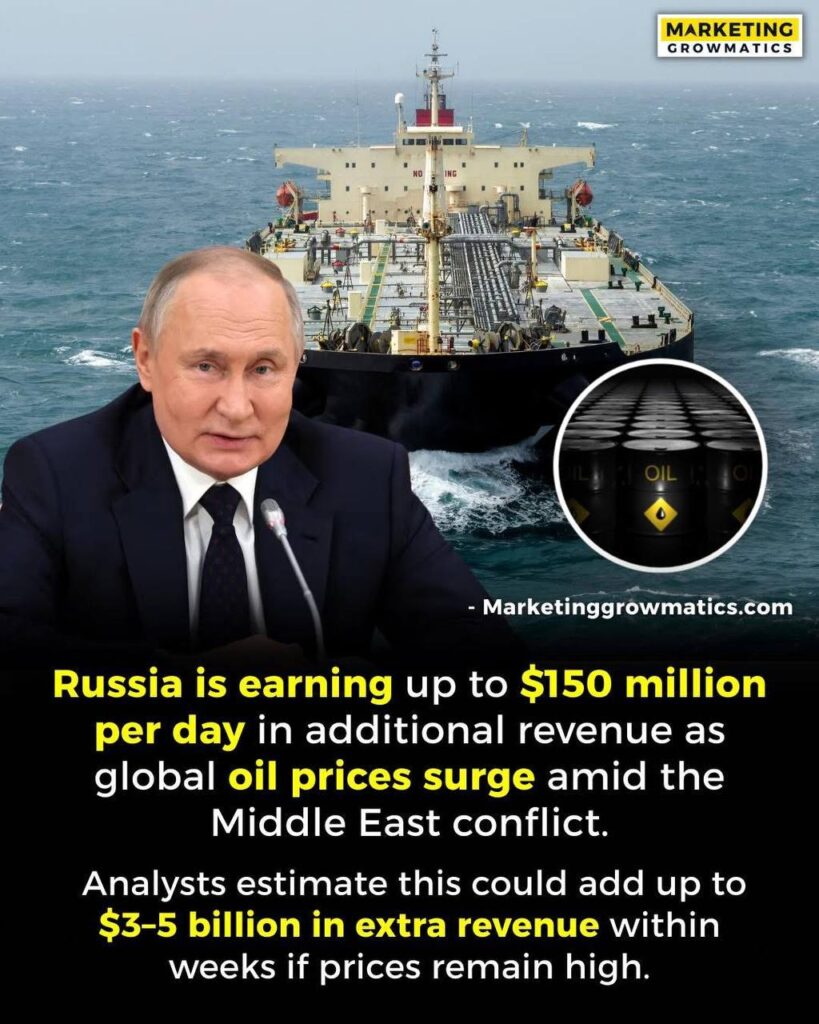
The escalating war involving Iran has sent shockwaves through global energy markets, creating unexpected winners and losers. While the conflict has heightened geopolitical tensions and disrupted oil flows across the Middle East, it has also delivered a surprising financial boost to Russia’s struggling oil sector.
As fighting and uncertainty spread across the region, one critical artery of global energy trade—the Strait of Hormuz—has become increasingly unstable. The disruption has triggered a surge in oil prices and forced major importing nations to search urgently for alternative supplies.
And that shift in demand is now funneling billions of dollars toward Russia, whose oil exports are suddenly becoming far more valuable.
Industry estimates suggest that Moscow is currently earning around $150 million in additional revenue every single day thanks to the spike in oil prices and increased demand for its crude.
A Windfall During a Difficult Time
For years, Russia’s energy sector has been under immense pressure due to international sanctions imposed after its 2022 invasion of Ukraine. Western restrictions targeted Russia’s financial systems, shipping networks, and energy exports in an attempt to weaken its economy.
But the sudden turmoil surrounding the war with Iran has unexpectedly opened a new economic lifeline.
According to industry analysts, Russia has already gained between $1.3 billion and $1.9 billion in extra tax revenue from oil exports during just the first 12 days of the conflict. If the current price surge continues through the rest of the month, the Russian government could collect as much as $3.3 billion to $5 billion in additional income.
For a country whose budget relies heavily on energy exports, this influx of cash could significantly ease fiscal pressure.
Why the Strait of Hormuz Matters So Much
The dramatic shift in the oil market is tied directly to the strategic importance of the Strait of Hormuz.
This narrow waterway—located between Iran and Oman—is one of the most important energy chokepoints on Earth. Roughly 20% of the world’s daily oil supply normally travels through this passage.
When tensions rise in this area, the entire global oil system feels the shock.
With threats to shipping routes and fears of disruptions growing, oil traders have reacted quickly by pushing prices upward. Shipping insurers have raised premiums, tanker routes have been reconsidered, and buyers have begun seeking more reliable supply sources outside the Gulf region.
That’s where Russia comes in.
Rising Demand From Asia
Two of the world’s fastest-growing energy consumers—India and China—are playing a key role in boosting Russia’s oil income.
Both countries have already been major buyers of discounted Russian crude in recent years. Now, with Middle Eastern supplies potentially at risk, demand for Russian oil is increasing even further.
Energy analysts say Asian buyers are eager to secure stable shipments, even if prices climb. Russian exporters, in turn, are benefiting from stronger bargaining power and rising global benchmarks.
The result is a sharp increase in Russia’s export revenues.
The Price of Russian Oil Is Climbing
A major driver behind the surge in Moscow’s earnings is the rising price of Urals crude, Russia’s primary export blend.
For much of the past two months, Urals crude had been trading at around $52 per barrel, reflecting discounts caused by sanctions and transportation limitations.
But since the Iran conflict began escalating, analysts say the price is now expected to average between $70 and $80 per barrel.
That increase dramatically changes Russia’s revenue outlook.
Because the Russian government collects taxes and duties based on oil prices, even a modest rise in crude prices can translate into billions of dollars in additional state income.
A Global Oil Market Under Pressure
The broader global oil market is now operating under heightened uncertainty.
Energy traders are watching developments in the Gulf region closely, especially any threats that could further disrupt shipments through the Strait of Hormuz.
If tensions escalate further, oil prices could spike even higher. That scenario would likely bring both economic consequences and political ripple effects across the world.
Countries heavily dependent on imported oil may face higher energy costs, inflation pressure, and fuel shortages. Meanwhile, major producers outside the conflict zone—like Russia—could continue reaping significant profits.
A Strategic Advantage for Moscow
For Russia, the situation represents an unexpected geopolitical advantage.
Despite years of sanctions aimed at weakening its energy revenues, the country remains one of the largest oil exporters on the planet. Global demand for energy means that when supply disruptions occur elsewhere, Russian crude quickly becomes a critical fallback option.
This reality highlights a long-standing truth of global energy politics: even heavily sanctioned producers can regain leverage when the world suddenly needs their resources.
The current crisis is proving exactly that.
What Happens Next?
Much now depends on how the Iran conflict unfolds in the coming weeks.
If shipping routes through the Gulf stabilize, oil prices could gradually fall again, reducing the windfall currently flowing into Russia’s treasury.
However, if tensions worsen and disruptions expand, energy markets could face a prolonged period of volatility—one that may continue benefiting Russia financially.
For now, the global oil system remains on edge.
And as the conflict reshapes supply chains and market dynamics, one outcome is already clear: the Iran war has not only shaken geopolitics—it has also reshaped the balance of power in the global energy market.