IRAN PANIC !! USS Tripoli (LHA-7) carrying 2,500 Marines tracked entering the Singapore Strait en route to the Middle East
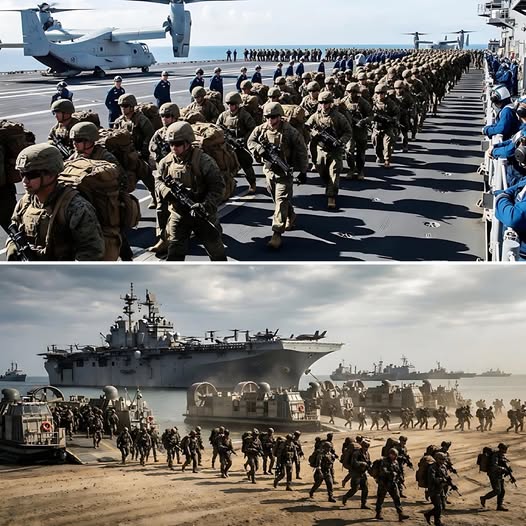
IRAN PANIC? A Floating Fortress Moves Toward the Middle East
What happens when a floating airbase loaded with elite Marines slips quietly through one of the busiest maritime chokepoints on Earth—and then heads straight toward the Middle East?
That question is now turning heads across defense circles worldwide.
A powerful U.S. Navy amphibious assault ship—believed to be the USS Tripoli (LHA-7)—has been tracked moving through the Singapore Strait after crossing the South China Sea. This narrow passage, part of the larger Strait of Malacca, is one of the most strategically vital waterways on the planet, carrying massive volumes of global trade every single day. Any military movement here is never unnoticed.
What makes this transit especially compelling is how it was revealed.
According to maritime tracking data highlighted by CNN, the vessel briefly activated its transponder—something naval ships typically do only in high-traffic zones to avoid collisions with commercial traffic. Outside these areas, such ships often operate in near silence, electronically invisible. That short signal was enough to spark intense speculation.
A Force Packed for Anything
Onboard is believed to be the 31st Marine Expeditionary Unit (MEU), one of the United States’ most elite rapid-response forces, based in Okinawa, Japan. This unit includes roughly 2,200 to 2,500 Marines and sailors, trained to deploy at a moment’s notice.
But this isn’t just a group of troops—it’s a fully integrated combat system.
The MEU combines:
- Ground combat forces ready for direct engagement
- Aviation units providing air superiority and transport
- Logistics teams sustaining operations in hostile environments
- Command elements coordinating complex missions
Together, they form a self-contained strike and response force capable of operating independently anywhere in the world.
A “Mini Aircraft Carrier” at Sea
The USS Tripoli isn’t your typical warship—it’s a floating base of operations.
Stretching nearly 850 feet long and displacing around 45,000 tons, it functions much like a light aircraft carrier. Its flight deck supports cutting-edge aircraft, including:
- F-35B stealth fighter jets capable of vertical landing
- MV-22 Osprey tiltrotor aircraft that combine helicopter flexibility with airplane speed
- Amphibious landing craft designed to deploy Marines directly onto hostile shores
This combination allows for seamless sea-to-land operations—whether it’s evacuating civilians, delivering humanitarian aid, or executing high-intensity combat missions.
Why This Movement Matters
The ship’s journey—from Okinawa through Southeast Asia and now toward the Middle East—has raised eyebrows for one key reason: timing.
While U.S. officials have confirmed a deployment order, they’ve released almost no details. The destination remains undisclosed. The mission objectives are unclear. The timeline is unknown.
This silence is not unusual.
In fact, it’s standard practice for rapid-response deployments, especially those involving forward-positioned Marine units. Operational secrecy ensures flexibility—and preserves the element of surprise.
Naval vessels like the USS Tripoli often move undetected, with tracking systems disabled. The brief signal near Singapore was likely nothing more than a safety measure—but it offered a rare glimpse into a much larger strategic movement.
And now, as this floating fortress continues its course, the world is left watching—and wondering—what comes next. ⚓
