Crude oil is often imagined as a ready-made fuel waiting beneath the earth’s surface—but in reality, it is far from usable in its natural form. What comes out of the ground is a thick, complex mixture of hydrocarbons that must undergo an intricate transformation before it becomes the gasoline in your car, the jet fuel powering aircraft, or the diesel moving global trade. This transformation happens inside massive industrial facilities known as refineries, where chemistry, engineering, and precision combine to turn raw crude into the fuels and materials that power modern life.
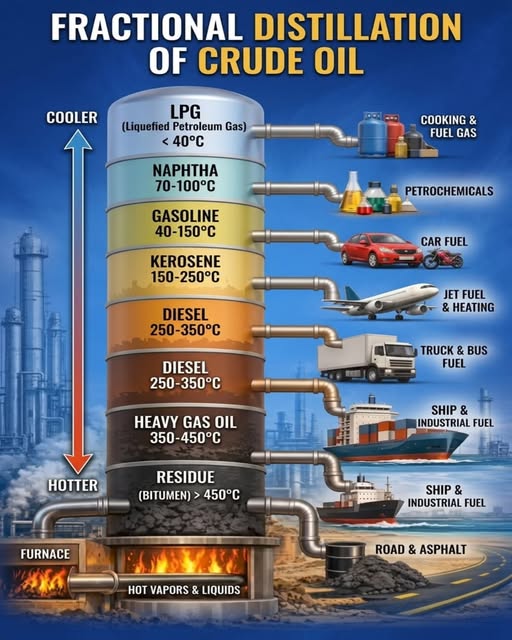
At its core, crude oil refining is about separation and reconstruction. The very first step in this journey is known as atmospheric distillation. Once crude oil arrives at a refinery, it is heated to extremely high temperatures—often over 350°C (662°F). This intense heat turns most of the liquid into vapor, which is then fed into a tall structure called a distillation tower. Inside this tower, a fascinating process unfolds, driven by differences in boiling points.
As the vapor rises through the tower, it begins to cool. Different hydrocarbons condense back into liquid at different temperatures, effectively sorting themselves into layers. The lightest components—such as gases and gasoline—rise to the very top. Slightly heavier fractions like naphtha and kerosene condense in the upper-middle sections. Diesel and gas oils form further down, while the heaviest materials, including residual oils, settle near the bottom. This initial separation is based on a fundamental principle of Fractional distillation, a cornerstone of modern refining.
However, this first split is only the beginning. If refineries stopped here, they would end up with far too much heavy, low-value material and not nearly enough of the high-demand fuels like gasoline and diesel. This imbalance is where the real ingenuity of refining comes into play.
The heavier fractions that remain after atmospheric distillation are sent to another unit called a vacuum distillation tower. By lowering the pressure inside the tower, these heavy components can be separated at lower temperatures, preventing them from breaking down prematurely. This step extracts additional useful fractions, but still leaves behind large, complex hydrocarbon molecules that are not yet suitable for fuel.
To convert these heavy molecules into more valuable products, refineries use processes such as cracking and hydrocracking. In cracking, long hydrocarbon chains are broken apart into shorter ones using heat, pressure, and sometimes catalysts. Hydrocracking goes a step further by introducing hydrogen, which not only breaks the molecules but also stabilizes them, producing cleaner-burning fuels. These processes are essential for maximizing the yield of high-value products from each barrel of crude.
Another critical step is reforming, where lower-quality hydrocarbons are rearranged at the molecular level to improve their performance. This process increases the octane rating of gasoline, making it more efficient and better suited for modern engines. Reforming also produces important byproducts used in the petrochemical industry, which are essential for making plastics, synthetic fibers, and countless everyday items.
By the time crude oil has passed through these stages—distillation, cracking, hydrocracking, and reforming—it has been completely transformed. What started as a single, unrefined mixture is now a wide array of specialized products, each tailored for a specific purpose.
From a standard 42-gallon barrel of crude oil, refineries typically produce a diverse mix of outputs. A significant portion becomes gasoline, the most widely used transportation fuel in many parts of the world. Diesel fuel, known for its efficiency and durability, is another major product, powering trucks, ships, and heavy machinery. Jet fuel, essential for aviation, is carefully refined to meet strict safety and performance standards.
Beyond fuels, refineries also produce lubricants that keep engines and machinery running smoothly, as well as feedstocks for the petrochemical industry. These feedstocks are the building blocks for products like plastics, detergents, fertilizers, and even pharmaceuticals. Meanwhile, the heaviest residues are turned into fuel oil, used in industrial applications, or bitumen, which is a key ingredient in asphalt for road construction.
The exact breakdown of products from each barrel depends on several factors, including the type of crude oil and the sophistication of the refinery. Light, sweet crude oils—those with lower sulfur content and lighter hydrocarbons—are generally easier and cheaper to refine into high-value products. Heavier, more sulfur-rich crudes require more complex processing but can still yield valuable outputs in advanced refineries equipped with cutting-edge technology.
Modern refineries are marvels of efficiency and optimization. Engineers continuously adjust conditions to maximize output, reduce waste, and meet environmental standards. Advanced monitoring systems and automation ensure that every stage of the process runs smoothly, while innovations in catalyst technology and process design continue to push the boundaries of what is possible.
Understanding how crude oil is transformed highlights just how complex and essential refining is to our daily lives. Every time you fill up your car, board a plane, or use a product made from petrochemicals, you are benefiting from this intricate process. It is not simply about extracting oil from the ground—it is about unlocking its potential through science and engineering.
In the end, crude oil is not a finished product but a starting point. Through heat, pressure, and chemical transformation, it becomes the fuels and materials that drive economies and connect the world. From the towering distillation columns to the advanced cracking units, every step in the refinery plays a vital role in turning raw hydrocarbons into the lifeblood of modern society.