🚨 At the Trump Accounts Summit, Nicki Minaj Held Hands with Donald Trump and Declared Herself “The President’s No. 1 Fan”
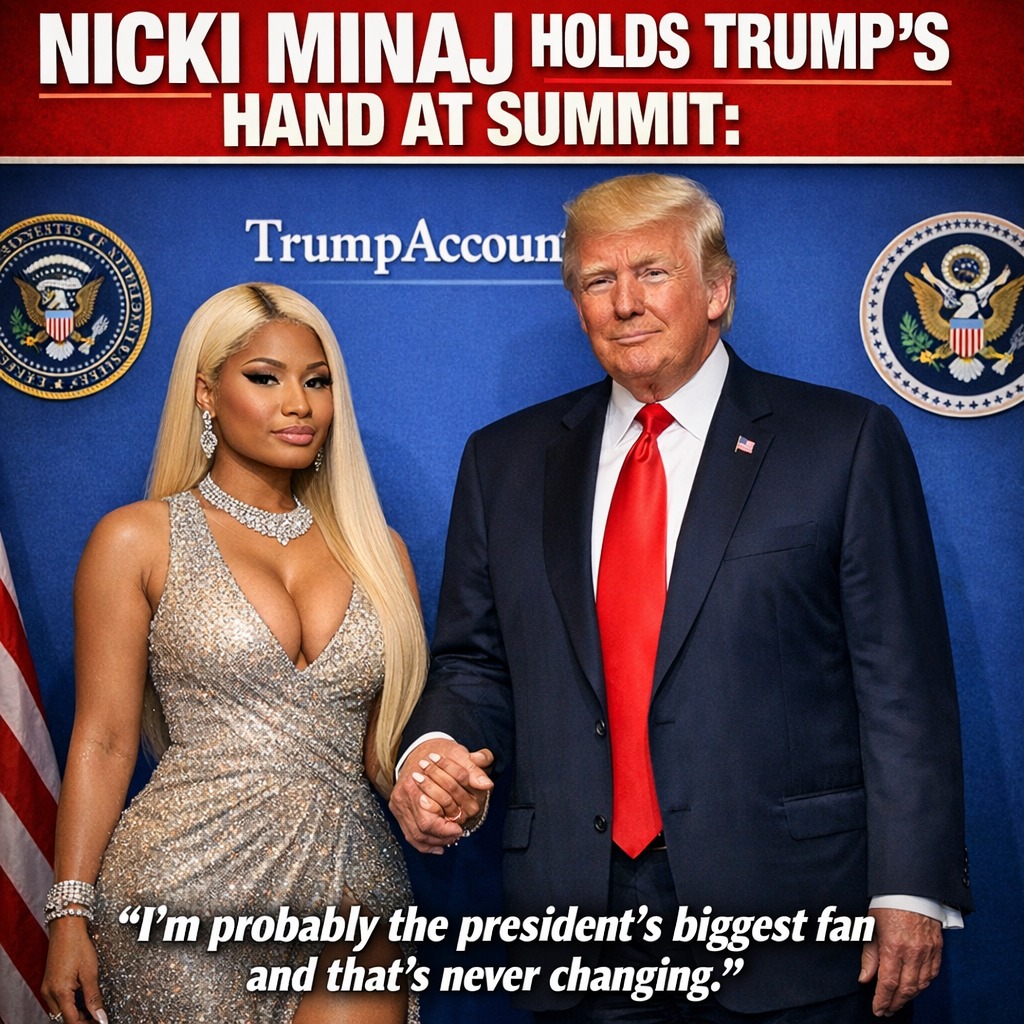
The image was instantly viral: Nicki Minaj—global pop icon, cultural provocateur, and one of the most influential artists of her generation—standing beside Donald Trump, holding his hand, smiling for the cameras, and declaring herself “The President’s No. 1 Fan.” The moment, which took place at the Trump Accounts Summit, detonated across social media platforms within minutes. Supporters celebrated it as a symbol of cultural realignment; critics denounced it as opportunism or betrayal. Memes, think pieces, outrage posts, and applause threads followed in rapid succession.
But beneath the spectacle lies a deeper story about politics, celebrity power, race, fandom, branding, and the transformation of public discourse in the digital age. This was not merely a pop star endorsing a politician. It was a collision of two megabrands that thrive on controversy, loyalty, and constant attention—and it says a great deal about where modern politics is heading.
A Moment Built for the Internet Age
The Trump Accounts Summit itself was already designed as a media-forward event: part political rally, part branding conference, part loyalty showcase. Trump has long understood that optics often matter more than policy detail, and the summit leaned heavily into spectacle. When Nicki Minaj appeared on stage, the moment felt choreographed for maximum impact—whether planned weeks in advance or improvised in the moment.
Holding hands is not a neutral gesture in politics. It communicates intimacy, trust, alignment, and symbolic unity. Nicki’s declaration—“The President’s No. 1 Fan”—was framed in the language of pop culture rather than governance, but that was precisely the point. It translated politics into fandom, turning presidential support into something akin to stan culture.
In an era where political identities are increasingly performative and emotional, this framing resonated instantly.
Nicki Minaj: A Career Defined by Defiance
To understand why this moment struck such a nerve, one must understand Nicki Minaj’s public persona. Throughout her career, she has resisted easy categorization. She has clashed with industry executives, media outlets, fellow artists, and fan bases alike. She has spoken openly about feeling targeted, misunderstood, or unfairly criticized—particularly by elite cultural institutions.
In recent years, Minaj has increasingly positioned herself as a skeptic of mainstream narratives, especially those promoted by traditional media and establishment voices. That skepticism has earned her both praise and condemnation. For her supporters, she represents independence and courage; for her critics, irresponsibility or contrarianism.
Standing beside Trump, Minaj appeared to lean fully into that defiant identity. The message was clear: I will not be told who I am allowed to support.
Trump’s Celebrity Strategy, Revisited
For Donald Trump, the appearance was vintage strategy. Long before entering politics, Trump cultivated relationships with celebrities, athletes, and entertainers. He understands fame as currency—and he understands that celebrity validation cuts through ideological resistance in ways that policy speeches rarely do.
Nicki Minaj is not just a celebrity; she commands one of the most passionate fan bases in the world. Her supporters are digitally fluent, fiercely loyal, and culturally influential. By appearing with her, Trump was not simply courting her endorsement—he was signaling openness to a demographic often assumed to be politically unreachable.
Whether that outreach translates into votes is secondary. The primary objective is attention, disruption, and reframing.
Race, Representation, and the Shock Factor
One reason the moment triggered such intense reaction is the intersection of race and political expectation. Black artists—especially women—are often assumed to align with certain political positions. When they deviate, the response can be disproportionately harsh.
Minaj’s declaration challenged a deeply entrenched narrative: that cultural legitimacy within Black America requires political conformity. By publicly supporting Trump—or at least expressing admiration—she disrupted that expectation. The backlash revealed how quickly political disagreement can turn into moral policing, especially when celebrities of color step outside perceived boundaries.
For Trump’s supporters, the moment was proof that political loyalty is not monolithic. For his critics, it was uncomfortable precisely because it complicated simplified narratives.
The Language of Fandom Replacing Civic Discourse
Perhaps the most revealing aspect of Minaj’s statement was her choice of words: “No. 1 Fan.” Not supporter. Not ally. Not voter. Fan.
This language reflects a broader transformation in politics, where leaders are consumed like brands, and citizens engage with them emotionally rather than institutionally. Trump has always benefited from this dynamic. His rallies resemble concerts; his supporters speak in the language of devotion; his critics engage with him obsessively.
By adopting fandom language, Minaj didn’t just endorse Trump—she normalized a mode of political engagement that is already dominant but rarely acknowledged so openly.
The Reaction Economy Goes Into Overdrive
Within hours, the internet split into predictable camps:
- Supporters praised Minaj for “thinking independently,” “breaking the mold,” and “saying what others are afraid to say.”
- Critics accused her of legitimizing harmful politics, chasing relevance, or betraying her audience.
- Media outlets raced to contextualize, explain, and speculate, often projecting broader cultural anxieties onto a single image.
- Brands and influencers carefully stayed silent or issued vague statements, wary of backlash.
The speed and intensity of the response underscored a central reality: controversy is now the dominant currency of visibility. Whether Minaj’s move was deeply ideological or primarily expressive almost became irrelevant. The conversation itself became the product.
Strategic Ambiguity or Genuine Alignment?
A key question remains unresolved: Was this a calculated political endorsement, or a symbolic gesture rooted in personal affinity and rebellion?
Nicki Minaj has never been a traditional political activist. Her public statements tend to be emotional, personal, and reactive rather than programmatic. That ambiguity may be intentional. By avoiding detailed policy alignment, she retains flexibility while still making a powerful statement about autonomy.
For Trump, ambiguity works just as well. He does not require ideological purity from supporters—only loyalty, visibility, and amplification.
What This Means for Celebrity Politics Going Forward
The Minaj–Trump moment reflects a broader trend: celebrities are no longer content to offer sanitized, one-directional endorsements. Increasingly, they are engaging politics as part of their personal brand narratives—messy, controversial, and emotionally charged.
This shift has consequences:
- Politics becomes more cultural than institutional
- Debate becomes more personal than analytical
- Symbolism outweighs substance in public perception
Whether this is healthy for democracy is an open question. But it is undeniably effective in capturing attention.
Conclusion: A Defining Image of the Era
Nicki Minaj holding hands with Donald Trump at the Trump Accounts Summit was not just a headline—it was a mirror held up to modern political culture. It revealed how fame, power, identity, and spectacle now intertwine in ways that blur traditional boundaries.
🚨 The moment will be remembered not because it changed policy, but because it crystallized a truth many are reluctant to admit:
Politics today is as much about loyalty, identity, and performance as it is about governance.
In that sense, Nicki Minaj’s declaration—provocative, polarizing, and unapologetic—was perfectly in tune with the age we live in.