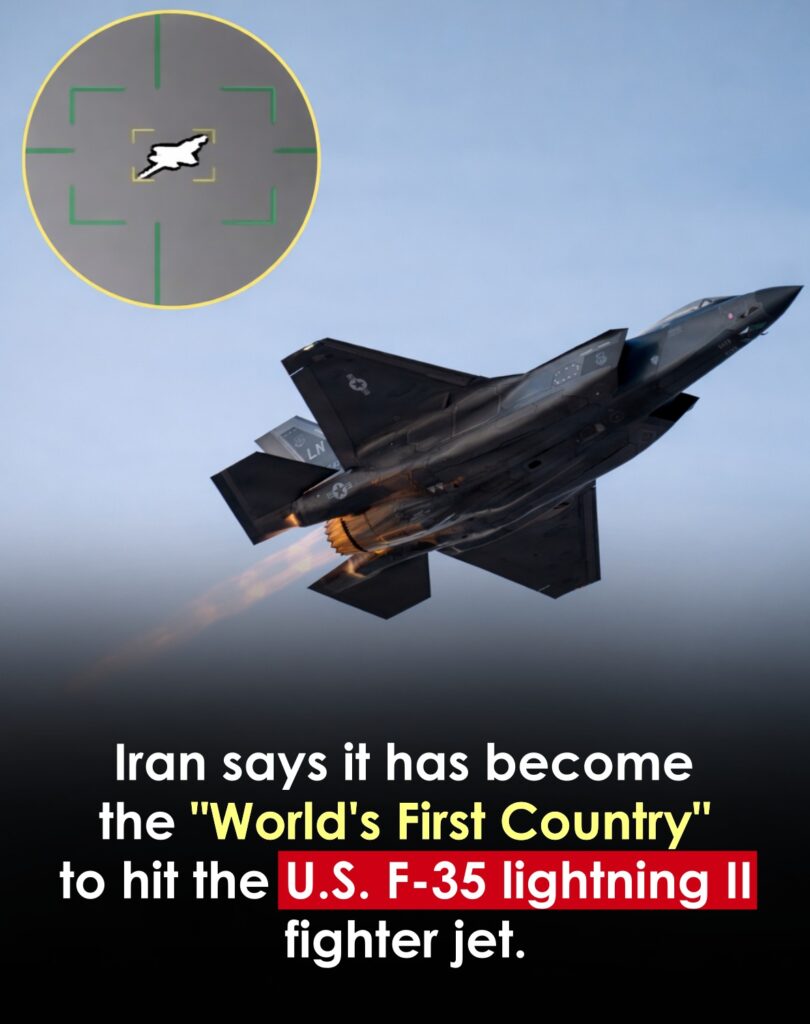
✈️🔥 A Clash in the Skies: Did Iran Really Strike an F-35?
In a dramatic and highly contested development, Iran has claimed that its air defense systems successfully struck one of the world’s most advanced fighter jets—the F-35 Lightning II—during a recent escalation in regional tensions. If verified, the incident could represent a watershed moment in modern aerial warfare, challenging long-held assumptions about stealth technology and air superiority.
But as with many घटनाएँ in high-stakes geopolitical conflicts, the truth remains murky.
🚨 Iran’s Bold Claim
According to Iranian officials, their “advanced air defense systems” managed to detect, track, and engage an incoming F-35—an aircraft specifically designed to evade radar and enemy detection. Iranian state media described the strike as “unprecedented,” suggesting it may be the first time a fifth-generation stealth fighter has been successfully hit in combat.
The systems allegedly involved are believed to include domestically upgraded platforms as well as variants inspired by the Russian-made S-300 missile system. Iran has invested heavily in layered air defense over the past decade, aiming to counter technologically superior adversaries.
Officials stopped short of providing concrete evidence such as wreckage or visual confirmation, but hinted that the aircraft’s fate was uncertain—adding that there was a “high probability” it may have crashed after sustaining damage.
Such a claim, if proven true, would send shockwaves through military circles worldwide.
🇺🇸 The U.S. Response
Officials from the United States Department of Defense have pushed back against Iran’s narrative. According to early reports, the aircraft in question did encounter an “in-flight emergency,” but managed to make a controlled emergency landing at a secure location.
More importantly, U.S. sources emphasized that:
- The pilot survived and is safe
- The aircraft was not destroyed in hostile territory
- An investigation is currently underway to determine the cause
While they did not fully deny that the aircraft may have been engaged, they cautioned against jumping to conclusions without verified evidence.
⚙️ Why the F-35 Matters
The F-35 Lightning II is not just any aircraft—it represents the cutting edge of modern military aviation. Built by Lockheed Martin, the F-35 is designed with stealth, advanced sensors, and networked warfare capabilities that allow it to operate in highly contested environments.
Key features include:
- Stealth technology to evade radar detection
- Advanced avionics and sensor fusion
- Electronic warfare capabilities
- Multirole versatility (air-to-air, air-to-ground, reconnaissance)
For years, the F-35 has been considered nearly untouchable by conventional air defense systems—making Iran’s claim particularly explosive.
🌍 A Turning Point in Air Warfare?
If Iran’s assertion is eventually confirmed, it could signal a major shift in the balance between stealth aircraft and air defense systems. Military analysts have long debated whether modern radar advancements—especially low-frequency and multi-static radar—could eventually neutralize stealth advantages.
This incident could suggest:
- Stealth is no longer invincible
- Air defense systems are evolving rapidly
- Future conflicts may be more contested in the air domain
However, skepticism remains high. Without physical evidence, independent verification, or satellite imagery, many experts urge caution.
🧠 Fog of War and Information Battles
It’s important to recognize that modern conflicts are fought not only with weapons, but also with information.
Claims like this serve multiple purposes:
- Boosting domestic morale
- Demonstrating technological strength
- Shaping international perception
Both Iran and the United States have strategic reasons to frame the narrative in their favor. In past conflicts, initial reports have often proven incomplete—or entirely inaccurate—once more data becomes available.
🔍 What Happens Next?
Investigations by the U.S. military and intelligence community will be crucial in determining:
- Whether the aircraft was actually hit
- If so, what system was used
- How the aircraft managed to survive (if it did)
- What vulnerabilities, if any, were exposed
Meanwhile, global defense observers—from NATO analysts to independent experts—will be closely watching for any confirmation.
⚖️ The Bigger Picture
Whether this turns out to be a confirmed shootdown, a near-miss, or simply a technical malfunction, the implications are significant.
If the F-35 Lightning II was truly engaged successfully, it could:
- Trigger new investments in stealth countermeasures
- Accelerate development of next-generation aircraft
- Reshape military doctrines worldwide
If not, it still highlights the growing sophistication of air defense systems and the increasing complexity of modern warfare.
🚀 Final Thoughts
In an era where technology defines military dominance, even the possibility of a stealth jet being struck is enough to capture global attention.
For now, the world is left with two competing narratives:
- Iran claiming a historic hit
- The United States insisting on pilot safety and aircraft recovery
Somewhere between those accounts lies the truth—waiting to be uncovered.
One thing is certain: the skies over modern battlefields are becoming more dangerous, more contested, and far less predictable than ever before.