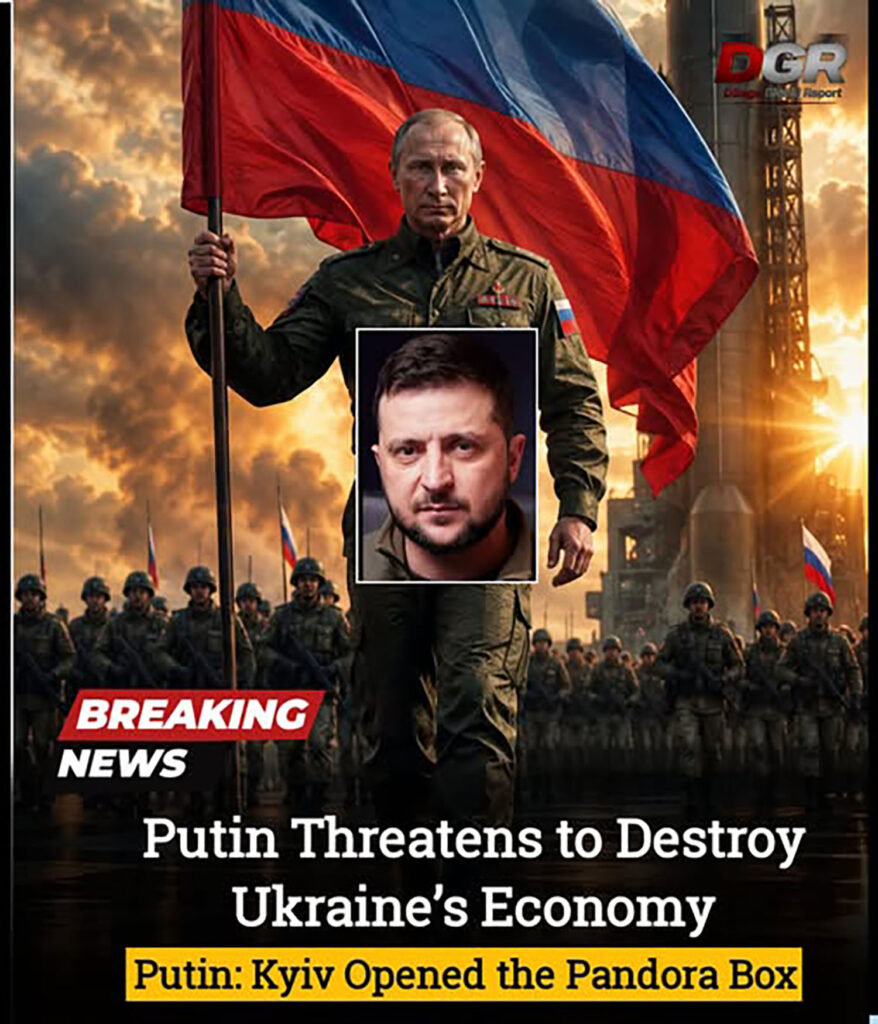
ussian President Vladimir Putin has issued a stark warning to Ukraine, threatening retaliation against some of the country’s most vulnerable economic sectors and accusing Kyiv of pushing the conflict into dangerous new territory.
Speaking about Ukraine’s attacks on Russian economic infrastructure, Putin said Kyiv had effectively opened what he described as a “PANDORA’S BOX” — a phrase signaling that Russia could respond by targeting economic areas that are vital to Ukraine’s survival and recovery.
Among the sectors Putin specifically highlighted was agriculture, one of the most important pillars of the Ukrainian economy. Ukraine is a major producer and exporter of agricultural commodities, and its farming and export industries have remained crucial sources of revenue despite the devastating impact of the war. Any major disruption to these activities could have consequences not only for Ukraine’s economy but also for international food markets.
Putin’s remarks therefore carry a broader warning: Moscow may be considering ways to increase pressure on Ukraine by striking at the economic infrastructure that keeps the country functioning.
The Russian president did not limit his criticism to Ukraine’s military actions. He also rejected certain peace proposals, describing some ideas as “exotic” and unacceptable to Moscow. His comments suggest that Russia remains far from accepting any settlement that it believes ignores its military and political objectives.
At the same time, Putin reiterated that Russia is not closing the door on negotiations. However, he emphasized that any potential talks must be based on what Moscow describes as the “realities on the ground.”
That condition is particularly significant because the phrase has often been used by Russian officials to refer to the territorial and military situation created during the conflict. For Ukraine and its allies, however, accepting such conditions could effectively mean recognizing circumstances created through military force — a point that has remained at the heart of disagreements over possible peace agreements.
Putin’s latest comments highlight the difficult balance between military escalation and diplomatic efforts. While Moscow continues to signal that negotiations remain theoretically possible, its stated conditions indicate that it expects any future talks to reflect Russia’s interpretation of the battlefield situation.
For Ukraine, the warning about economic retaliation adds another layer of uncertainty. The country is already dealing with the enormous costs of war, damaged infrastructure, disrupted trade, and pressure on its public finances. Threats against agriculture and exports could further complicate efforts to maintain economic stability.
The agricultural sector is especially sensitive because it connects Ukraine’s domestic economy with global markets. Farmers, exporters, ports, transport companies, and international buyers all depend on the continued movement of Ukrainian agricultural products. Further attacks or restrictions could therefore create consequences far beyond the immediate battlefield.
Putin’s “PANDORA’S BOX” warning also reflects the increasingly expansive nature of the conflict. As both sides seek to weaken the other’s ability to sustain military operations, economic infrastructure has become an increasingly important target.
The message from Moscow is clear: Russia says attacks on its economic infrastructure will carry consequences, and Ukraine’s own economic lifelines could become part of that retaliation.
Yet Putin’s simultaneous reference to negotiations leaves a narrow door open for diplomacy. Whether that door can lead to meaningful talks will depend heavily on whether Russia and Ukraine can bridge their sharply opposing views over territory, security, and the conditions for peace.
For now, Putin’s remarks suggest that Moscow is preparing for continued confrontation while keeping negotiations on the table — but only on terms shaped by what Russia considers the “realities on the ground.”