For generations, Pluto was little more than a distant mystery.
To the naked eye, it was invisible. Even through powerful telescopes, it appeared as little more than a faint point of light buried in the darkness of the outer solar system. Astronomers debated its size, its nature, and even its place in our cosmic family.
But then humanity did something extraordinary.
We sent a spacecraft across the solar system to see Pluto up close.
The journey began in 2006, when NASA launched New Horizons, a compact spacecraft roughly the size of a piano. Its destination was a world so remote that sunlight itself takes hours to travel from the Sun to its surface.
New Horizons didn’t simply travel far.
It traveled farther than most human-made machines had ever gone, crossing billions of miles through an unforgiving region of space where temperatures plunge, sunlight grows weak, and communication with Earth becomes a slow conversation across unimaginable distances.
For nearly a decade, the spacecraft raced toward its destination.
Nine years.
Billions of miles.
Countless calculations.
And one moment that would change our understanding of Pluto forever.
On July 14, 2015, New Horizons finally reached Pluto.
After years of anticipation, the spacecraft swept past the dwarf planet at tremendous speed, capturing images as it flew through the distant darkness.
And suddenly, Pluto wasn’t a blurry dot anymore.
It was a world.
A real world with mountains, valleys, plains, ridges and layers of geological history written across its frozen surface.
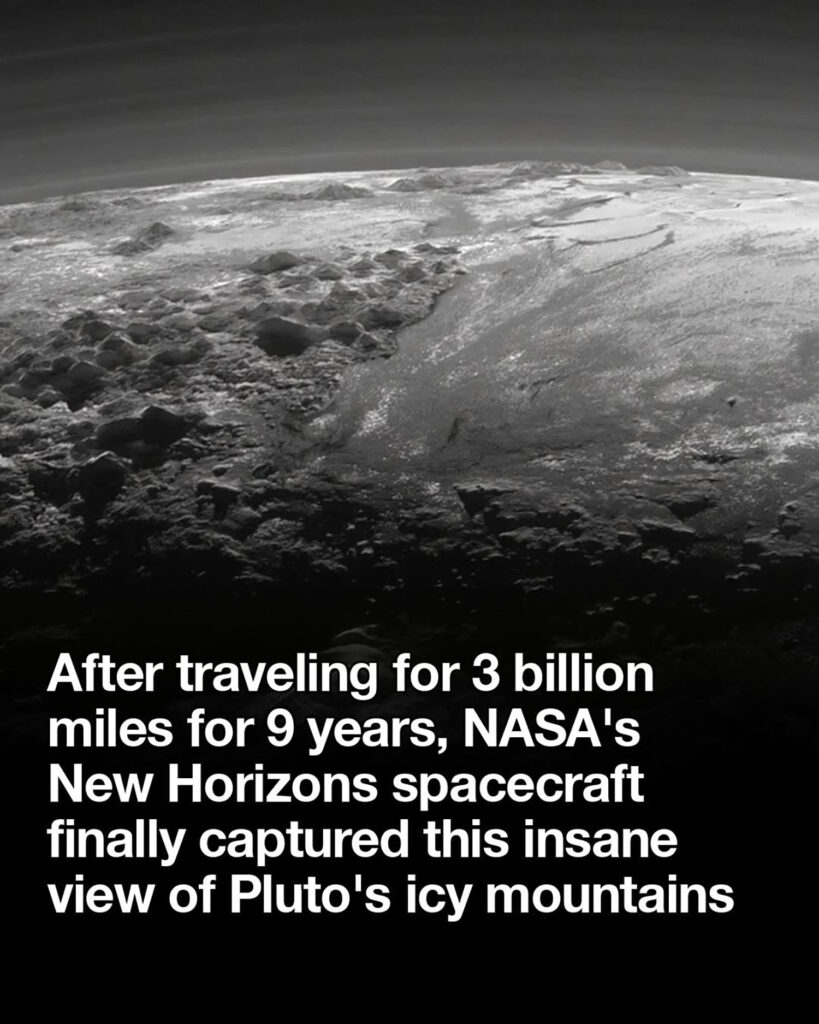
Among the most breathtaking discoveries were enormous mountains made largely of water ice. Some rose several miles above the surrounding landscape, their sharp peaks standing dramatically against Pluto’s distant horizon.
It was a scene nobody had ever witnessed before.
For most of human history, Pluto had existed only as an idea—a tiny, mysterious object at the edge of our known planetary neighborhood.
Then, in a matter of minutes, New Horizons transformed that mystery into a landscape.
The spacecraft revealed a surprisingly complex world.
Pluto’s surface was not the lifeless, featureless ball many scientists might once have imagined. Instead, it displayed an astonishing variety of terrain. Vast plains stretched across its surface. Mountains towered over frozen regions. Strange ridges and fractures suggested a complicated geological past.
And above it all was Pluto’s thin atmosphere, creating a delicate blue haze around the distant horizon.
One photograph captured that beauty in a way that words could barely describe.
Looking back toward Pluto with the Sun behind the dwarf planet, New Horizons photographed layers of atmospheric haze glowing around its silhouette.
The result was almost dreamlike.
The distant world appeared to have a glowing halo, while mountains and rugged terrain rose in silhouette against the hazy atmosphere.
It looked less like a cold object billions of miles away and more like an alien world suspended in a cosmic twilight.
But perhaps the most incredible part of the photograph wasn’t what appeared inside the frame.
It was the journey required to capture it.
The light from Pluto had traveled for more than four hours before reaching Earth.
Think about that.
The photons carrying information about those mountains, plains and hazy skies began their journey across the darkness of space long before they arrived at our planet.
By the time humans received that image, Pluto was already billions of miles away.
The photograph was not merely a picture.
It was a message from the edge of the solar system.
And it took years of human effort to receive it.
Scientists and engineers had designed New Horizons to survive an extraordinary journey. The spacecraft had to navigate through deep space with incredible precision, relying on carefully calculated trajectories and commands sent from Earth.
There was no quick rescue if something went wrong.
No mechanic could reach it.
No astronaut could repair it.
If New Horizons failed during its encounter with Pluto, the opportunity would be gone.
Instead, the spacecraft performed its mission.
And humanity finally got to see Pluto.
The images challenged our expectations.
A world once considered a tiny, frozen curiosity turned out to be surprisingly dynamic and visually spectacular. Its surface told a story of ancient impacts, shifting materials and geological processes that scientists are still working to understand.
Perhaps that’s what makes the New Horizons photographs so powerful.
They remind us that the universe is often stranger and more beautiful than our imagination.
Before New Horizons arrived, Pluto was an abstraction.
Afterward, it became a place.
A place with mountains.
A place with weather.
A place with an atmosphere.
A place with a landscape that could be explored through photographs.
And although Pluto is extraordinarily distant, the mission created an unexpected sense of intimacy. For the first time, humanity could look at a world nearly four billion miles from the Sun and recognize familiar geological features.
Mountains are mountains.
Horizon lines are horizons.
Shadows fall across frozen terrain just as they do on Earth.
Yet everything about the environment is radically different.
The mountains are made of ice.
The temperatures are unimaginably cold.
The sunlight is incredibly faint.
And the entire landscape exists in a region of the solar system where darkness dominates.
Still, a tiny spacecraft traveled there.
It crossed the vast emptiness between worlds and delivered a message home.
That achievement represents something larger than a NASA mission.
It represents curiosity.
Human beings looked at a faint object in the night sky and decided they wanted to know what it really looked like.
So they built a machine.
They launched it.
They waited.
For nine years, New Horizons traveled through space toward a destination that had once seemed almost unreachable.
And when it finally arrived, it gave us something priceless: a new world to wonder about.
Today, those images remain among the most extraordinary photographs ever captured by a spacecraft.
They show us that even the smallest and most distant worlds can hold enormous stories.
Pluto was once just a smudge.
Then it became a dot.
Then a destination.
And finally, through the eyes of New Horizons, it became a landscape.
A landscape of ice and mountains beneath a hazy alien sky.
The photograph took more than four hours to reach Earth.
But humanity had been waiting far longer.
Nine years.
Three billion-plus miles.
One tiny spacecraft.
One distant world.
And one unforgettable glimpse that made the entire journey worth it.